Where is the animal to be found?
The blacktip shark can be seen in the Red Sea and is commonly found throughout the Indian Ocean, as well as in the tropical Pacific as far east as Hawaii and French Polynesia. In the Pacific, this shark is found from Japan to Australia and New Caledonia.
The blacktip shark is a reef shark that lives in coral environments. A coastal shark, it lives alone or in small groups, from the surface to a depth of 75 to 100 m. It lives in reefs, flat areas, lagoons and mangrove swamps. It is sometimes seen in freshwater areas close to the sea.
Adults live in slightly deeper waters, while young sharks often live in mangrove swamps.
How can it be recognised?
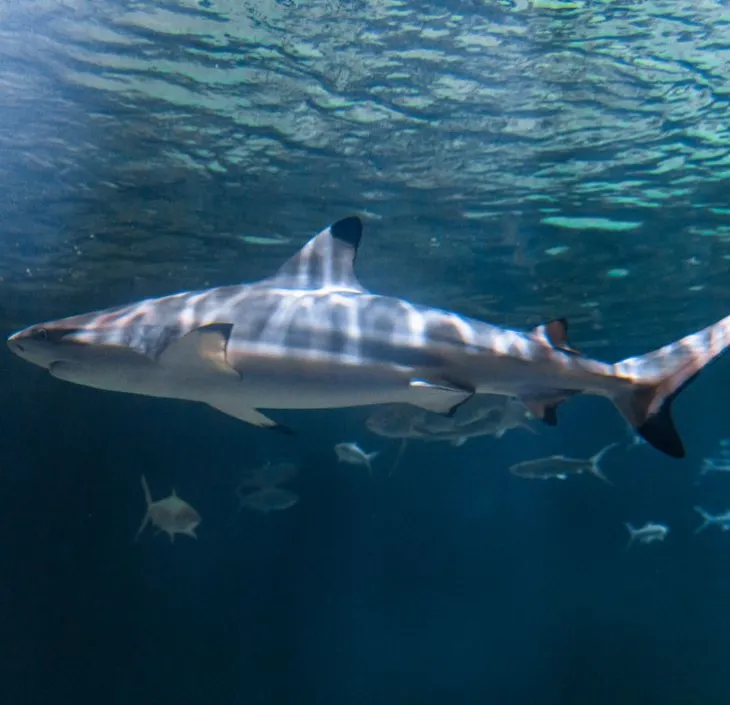
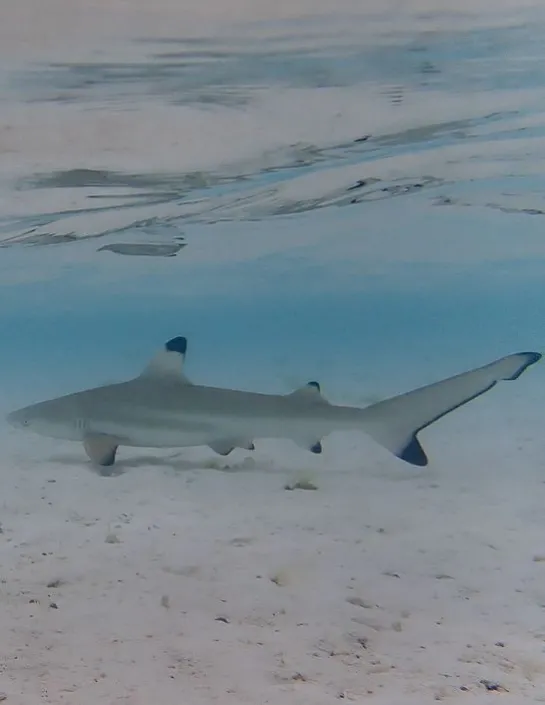
- The Blacktip shark is characterised by the black tip of its dorsal fin, which is easy to spot when its fin emerges from the shallow waters in which it lives. The other fins also have a black tip.
- Ranging in size from 1.5 to 1.8 m, this small shark has a beige-brown spindle-shaped body with a white belly.
- It has a rounded snout and an arched mouth in a ventral position.
- Its dorsal and anal fins are symmetrical.
- Its caudal fin has an upper lobe that is more developed than the lower lobe and a black line along its entire length.
What is distinctive about it?
- The blacktip shark is a viviparous species, meaning that the young sharks develop inside the female's body. After a gestation period of 10 to 16 months, the female gives birth to between 2 and 4 young sharks measuring between 40 and 50 cm.
- Sexual maturity is reached when the shark reaches a size of 0.90 to 1 m for the male and 1 to 1.10 m for the female. The sharks are then between 8 and 9 years old.
- The male can be distinguished by the presence of reproductive organs called pterygopods located on the pelvic fins.
- They live alone or in small groups.
Threats and protective measures
- Classified as Vulnerable by the IUCN, the blacktip shark faces threats such as overfishing, degradation of coastal habitats and pollution.
- The Carcharhinidae family has been listed in Appendix II of CITES since the Conference of the Parties held in Panama in 2022, which took effect in February 2023. This listing aims to regulate trade in this species and ensure its conservation.
- The blacktip shark is caught as by-catch in industrial and artisanal fisheries throughout much of its range, and is often kept for its fins, meat, skin, teeth and liver.
Sources