Biodiversity 4mn
Daily care for the manta ray at Nausicaá
The manta ray fascinates visitors with its majestic appearance. How do aquarists and the veterinarian care for this animal on a daily basis?

A giant of the oceans under close scrutiny
La raie Manta Mobula birostris, arrivée à Nausicaá en 2018, continue d’émerveiller les visiteurs qui s’arrêtent devant le grand bassin de la haute mer et assistent à ses passages aériens et à ses loopings facétieux.
The Manta ray Mobula birostris, which arrived at Nausicaá in 2018, continues to amaze visitors who stop in front of the large open sea tank to watch its aerial passes and playful loops.
With its impressive wingspan, it towers over the other rays in the tank. When it arrived in 2018, it measured 2.50 metres and weighed 180 kg.
Today she has grown considerably, and the team of carers and divers at the large pool have developed expertise in monitoring a large animal that is constantly moving around in a pool containing several million litres of water.
Measurements, feeding, medical training—these multiple tasks keep aquarists and the veterinarian busy and are a real daily challenge in the service of animal welfare!
Technological innovation for measuring the manta ray
Monitoring an animal involves regularly measuring its height and weight. But how do you measure an animal of this size that is constantly swimming?
Imagine divers with a tape measure trying to take the measurements of a manta ray!
The solution came from Prodrones, an expert in aerial imaging.
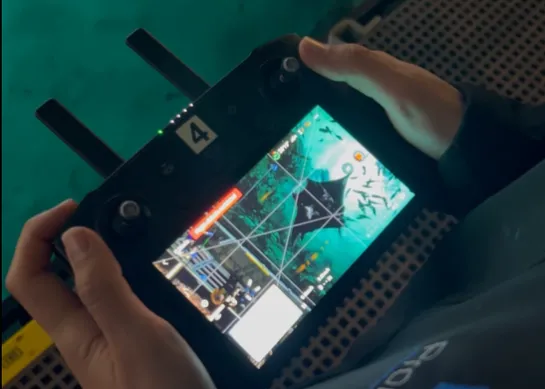
Incubated at Nausicaá's Blue Living Lab, the team worked on improving its mapping tool and took the opportunity to attempt this unprecedented operation: measuring the manta ray using drone technology.
This completely non-intrusive approach provides fairly accurate data on the animal's growth, without direct contact or stress. The results show that the manta ray now measures approximately 4 metres and weighs an estimated 800 kg. This information is essential for fine-tuning its monitoring and care.
Food: carefully prepared menus, tailored to individual needs and monitored on a daily basis
Like other species in the large tank, the manta ray has become accustomed to coming to feed several times a day. When the aquarist arrives, the manta ray approaches and receives its food ration.
The diet is tailored to his needs and varies according to observations and seasons. His food intake is recorded daily to ensure the most accurate monitoring possible. This allows us to adjust the quantities or composition of meals if necessary and to closely monitor the animal's general condition.
The manta ray currently eats 12 kg of food divided into two meals, one in the morning and the second in the afternoon. The menu usually consists of minced shrimp and small fish, to which vitamins are added.
Medical monitoring protocols: observing and treating without coercion
Caring for animals at Nausicaá means ensuring their well-being and health every day. This involves being able to approach them to observe their condition and behaviour and intervene if necessary.
With an animal as impressive as the manta ray, this is a considerable challenge and requires the implementation of underwater protocols to access the animal while diving.
The lead aquarist and veterinarian at Nausicaá have been implementing a medical training protocol for several months, which is followed by the diver-caretakers. They travelled to Japan to visit a partner aquarium, where they observed and trained in a gentle, non-coercive approach to the animals.
Patience is required to see the animal approach the divers through repetition, stay close to them and then accept contact. The goal is to eventually be able to perform simple procedures such as blood tests or ultrasounds while diving, as close as possible to the animal.
These approach exercises are carried out gradually, depending on the mood and cooperation of the manta ray, and can take many months before satisfactory results are achieved. The progress of these exercises is carefully documented in order to observe changes in the ray's behaviour.
An exemplary approach to animal welfare
These practices, developed in close collaboration between keepers and the veterinarian, are part of a process of continuous improvement in animal care and welfare. They illustrate Nausicaá's commitment to using science and innovation to provide animals with increasingly respectful conditions, while contributing to a better scientific understanding of ocean species.
Other articles
Seals, osteopathy and medical training
Nausicaá's professions 4mn
The health and well-being of sea lions depends on daily trai...
Discover the incredible medical training...
Biodiversity 5mn
How does medical training contribute to animal welfare?
Nausicaá, coral breeder
Nausicaá's professions 2mn
Nausicaá has been breeding coral in its aquariological reser...