Biodiversity 5mn
Discover the incredible medical training of the moray eel
How does medical training contribute to animal welfare?

Did you know that it is possible to teach fish gestures and behaviours that improve their daily well-being?
At Nausicaá, caretakers implement protocols that meet the physiological needs of marine animals. These routines facilitate food distribution and enable the acquisition of new behaviours.
They also contribute to their enrichment and gradually familiarise the animals with medical procedures. These learning experiences help to ensure optimal living conditions for the animals at the centre.
But how do you train a fish?
While the results of sea lion training are regularly presented and explained to visitors at Nausicaá, it is more difficult to imagine how responsive a fish is during training.
To understand this, we met with Louise, a caretaker in the temperate zone. When she arrived at Nausicaá four years ago, she set up a training programme with the common moray eels Muraena helena.
A labour of patience and trust
Targeted feeding
Louise quickly noticed how responsive these fish were when she established a feeding routine: "The first stage of training was feeding with tongs. This routine has two advantages: seeing the animals up close and checking their food intake. The four moray eels in the tank learned this in two sessions. In comparison, the same exercise with wolf eels took longer."
Encouraged by this initial success, Louise then introduced a target to guide the moray eel and lead it to the food distribution point. "When the action is performed correctly, the animal is rewarded. The behaviour is thus gradually established over time." This learning process takes place at the animal's own pace, without forcing it.
Each session begins and ends with an audible signal, indicating the duration of the exercise. Regularity pays off, but progress is never permanent: a capture can break the bond of trust, and lack of training can diminish the skills acquired.
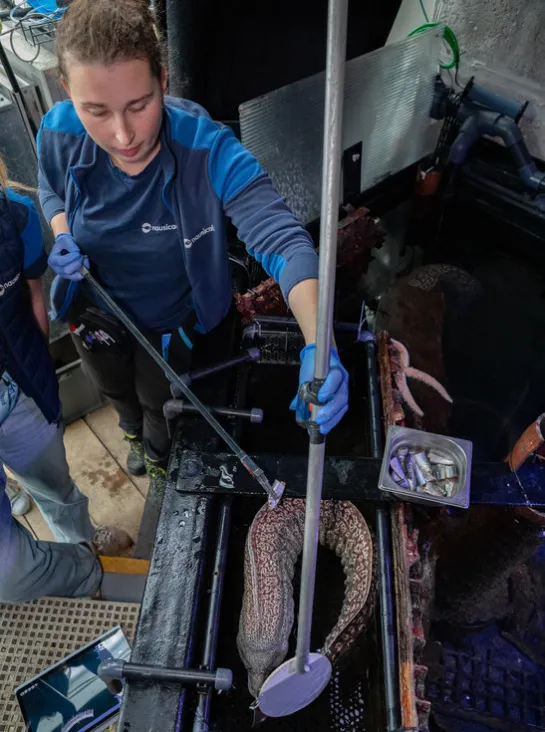
Louise continued her training by introducing an enclosure into which the moray eel enters. The eel appreciates the comfort and security that confinement provides. ‘The isolation it provides has a calming effect that makes handling easier,’ Louise tells us. The caretaker takes advantage of the moray eel's confinement in the compartment to check its health, but also to get it used to being touched by objects that simulate probes or syringes.
The veterinary benefits of training
This latest development is of interest for veterinary monitoring of the animal: it will enable medical examinations such as ultrasounds and blood tests to be carried out, in addition to individualising food rations and medication distribution. An initial test has already been carried out safely to administer injections to one of the moray eels.
"The challenge is to keep them in a position that allows for examination. A prolonged ultrasound scan will, for example, enable us to identify the sex of these moray eels, which cannot be determined visually," adds Louise.
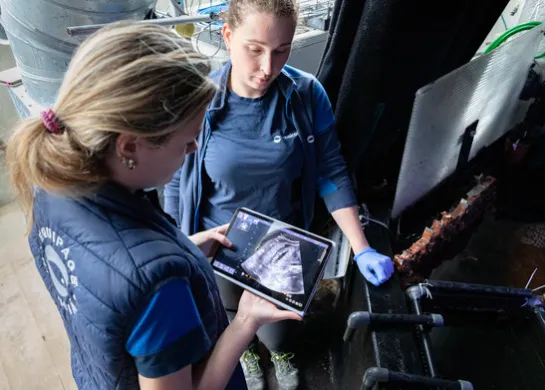
Sasha, Nausicaá's veterinarian, is closely monitoring this training: ‘We will be able to treat the animal and perform ultrasounds without stress or anaesthetic risk,’ she tells us. This is particularly interesting given that there is little literature on this species and that all the analyses from the ultrasounds will be invaluable in understanding and treating these fish.
22 species trained at Nausicaá
Moray eels are not the only species Louise trains. In the Californian tank, the Californian wrasse, or sheep's head, is getting used to obtaining its food by approaching a target; leopard sharks, which tend to live at the bottom of the tank, are trained to come to the surface of the aquarium to get their food. The young keeper also works in the reserves training wolf eels.
If we add the various species of rays in the large pool, sharks, sea lions and other species, there are currently 22 species that have been benefiting from behavioural training for several years.
These training sessions benefit from the support of a veterinarian specialising in animal behaviour in the design, evaluation and development of the training programmes. This Belgian veterinarian describes himself as a "trainer of trainers" and provides advice, solutions and tips to help improve training based on the principles of applied ethology and scientific rigour.
"Training here is a gentle method of psychological restraint based on reward rather than punishment," he tells us. "Food is a motivator that encourages interaction with the keeper and behavioural enrichment."
He adds: ‘The advantage of training is that it allows us to get closer to the animals. There is a care objective and also a potential educational objective for visitors.’
Training is indeed a wonderful tool for mediation: it allows for a new approach to and understanding of living creatures by observing the interactions between keepers and animals.
At Nausicaá, this gentle and gradual approach is part of the desire to raise public awareness of the richness and fragility of the marine world.
Other articles
Black tip sharks join the Tropical getaw...
Biodiversity 3mn
New sharks to discover in the new tropical environment.
Tropical getaway, behind the scenes of a...
Coral 1mn
After three years of work, the tropical area has regained it...
Alexis Rosenfeld, a committed sponsor fo...
Coral 1mn
Meet this passionate photographer, witness to the evolution ...