Biodiversity Coral 3mn
Black tip sharks join the Tropical getaway exhibition
New sharks to discover in the new tropical environment.

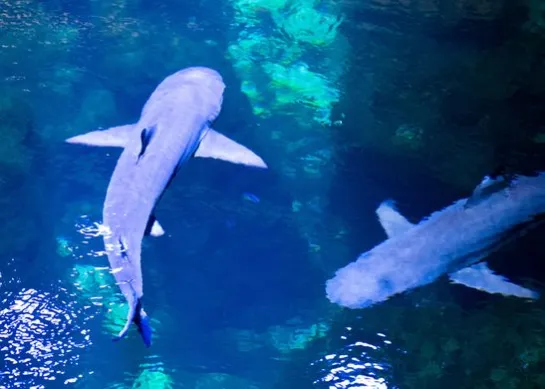
Following the return of the zebra sharks to the tropical lagoon, nine black tip reef sharks have joined the new Tropical Getaway exhibit.
This group of three males and six females populates the completely renovated aquarium, embodying the passageway in a coral ecosystem, the link between the lagoon and the open sea.
These sharks come from two partner aquariums, the Liège Aquarium and the Paris Aquarium at Trocadéro. At Nausicaá, these sharks will find a new, larger space where they can flourish in the company of a giant grouper, impressive for its size and massive body, trevally, surgeonfish, angelfish and squirrelfish.
A new species in the tropical exhibition
These lively little sharks are replacing the sand tiger sharks that have been present since Nausicaá opened. They left the centre three years ago, before work began on this spectacular project. They have been transferred to partner aquariums in Le Croisic and Budapest.
Exchanges between aquariums are frequent and are always considered in order to offer the animals the best possible living conditions.
With their small size and liveliness, these black tip reef sharks bring a breath of fresh air to the centre's aquariums. Above all, they are representative of reef sharks, which are at the top of the tropical food chain.
Who is the black tip shark?
This reef shark, easily spotted by the black tips on its fins, lives in the shallow waters of coral reefs, flats and lagoons. It also ventures into mangrove areas.
A small, lively shark, it lives alone or in small groups, as here at Nausicaá. This species of shark is classified as vulnerable on the IUCN red list and is the subject of a European conservation programme, the EEP - EAZA Ex situ programme, in which Nausicaá participates.
Coming soon: training for the well-being of sharks
Nausicaá's caretakers will soon be introducing food training for the black tip sharks.
These sharks will become accustomed to picking up their food ration "at the target". The food will be distributed at a precise point, marked by the target. This technique, which caretakers already use with other species of shark or fish, makes it possible to record the quantities distributed to each individual, but it also allows aquarists to monitor the state of health of the individuals.
To make it easier to recognise these sharks, the caretakers will be creating a trombinoscope identifying the different distinctive features of each one. The training is a real plus in terms of monitoring these animals and ensuring their well-being.
Other articles
Tropical getaway, behind the scenes of a...
Coral 1mn
After three years of work, the tropical area has regained it...

Alexis Rosenfeld, a committed sponsor fo...
Coral 1mn
Meet this passionate photographer, witness to the evolution ...
The sharks of Nausicaá: have you seen th...
Biodiversity 4mn
Do you know how many species of sharks there are to discover...