Where is the animal to be found?
This fish inhabits the tropical and subtropical waters of the Indo-Pacific, stretching from the east coast of Africa (including the Red Sea) to French Polynesia, and from southern Japan to the southern Great Barrier Reef.
It is found in deep lagoons, passes and the outer slopes of coral reefs, generally between 2 and 75 metres deep, but this species is often seen below 10 metres.
How can it be recognised?
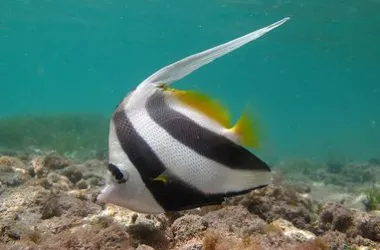
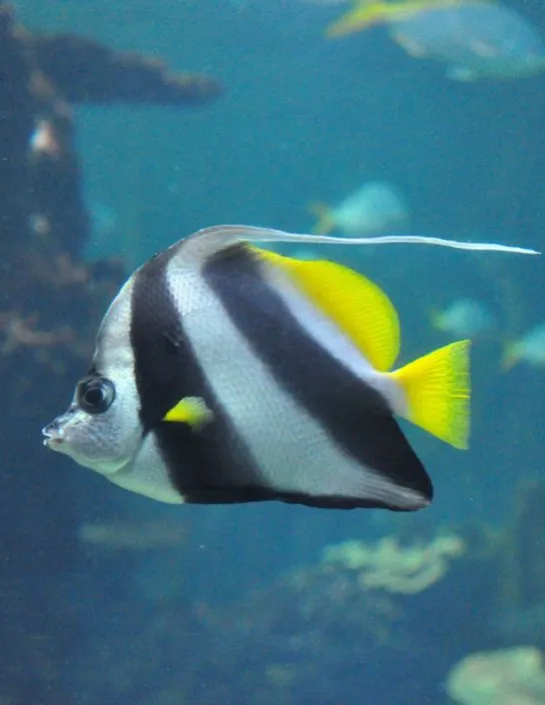
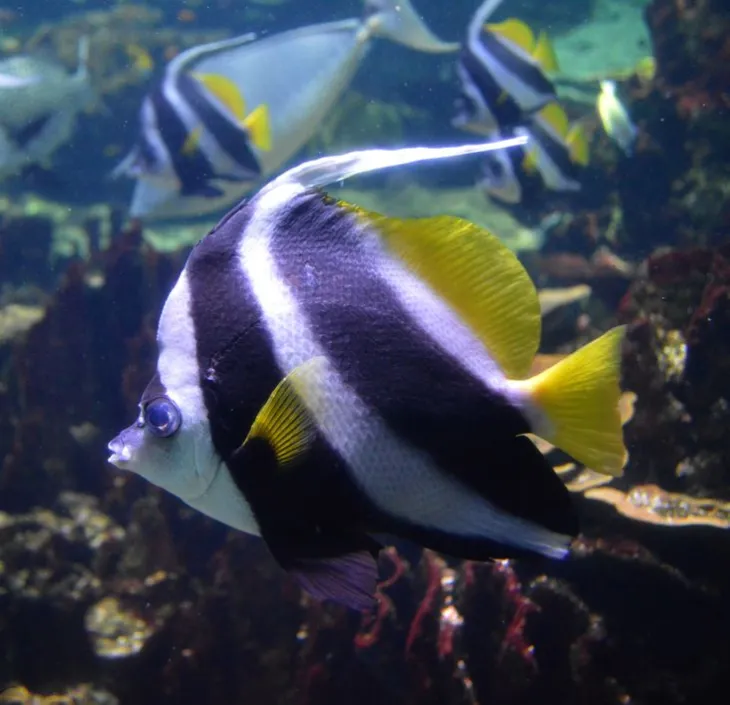
- This tropical fish is distinguished by its dorsal fin, which extends in a long white filament that gives it its name of "bannerfish".
- Its laterally compressed body has black and white stripes, while its dorsal and caudal fins are bright yellow.
- A black band covers its eyes, and its head ends in a pointed mouth.
- Adult bannerfish have a disc-shaped body, while juveniles are more triangular.
What is distinctive about it?
- Adults live singly, in pairs or sometimes in small groups, almost always swimming close to the reef substrate.
- They feed mainly on plankton, but supplement their diet with benthic invertebrates.
- Juveniles, often solitary, have been observed taking parasites from other fish and live in shallower reefs.
- During spawning episodes, fertilisation takes place in open water with the release of gametes. The eggs and larvae are planktonic. The larval phase ends after 40 days and the juveniles return to the reefs.
Threats and protective measures
Although classified as 'Least Concern' by the IUCN, Heniochus acuminatus is vulnerable to disturbances to coral reefs, such as pollution, overfishing and extreme weather events.
No specific conservation measures are currently in place.