demoiselle bleue Chromis viridis

Blue green damselfish

  Tropical reef fish

Identity card

Blue green damselfish

Scientific name:
Chromis viridis
Family:
Pomacentridae
Class:
Actinopterygii
Phylum:
Chordata
Year of description:
Cuvier, 1830
IUCN Status:
Least Concern
Distribution:

Red Sea and Indo-Pacific.

Habitat:

Between 1 and 20 metres deep.

Size:

10 cm max., 5 to 8 cm.

Diet:

Plankton.

Longevity:

3 to 4 years.


The damselfish hides inside a coral reef at night to sleep.

Guillaume, head of the tropical sector

When asleep, fish move their fins twice as much as when awake. These movements improve hydrodynamics and maintain the level of oxygen in the water necessary for the internal parts of branching coral reefs.

This is a mutualistic relationship between the fish and the coral, which serves as a refuge for the fish.

Did you know?

The damselfish live in shoals, close to the corals where they can take shelter at the slightest sign of danger.

Where can I find the animal?

This species inhabits hard substrates in lagoons and subtidal reef flats. They are often found in groups among Acropora and Pocillopora branching corals.

It is found in the Red Sea, throughout the Indian Ocean and in the Pacific from Australia to the Tuamotu Archipelago, and from southern Japan to New Caledonia and the Tonga Islands. 

How can you recognise it?

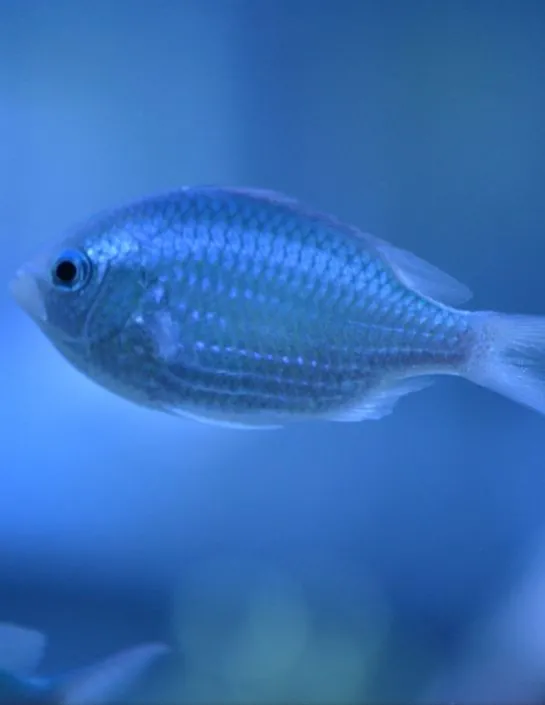
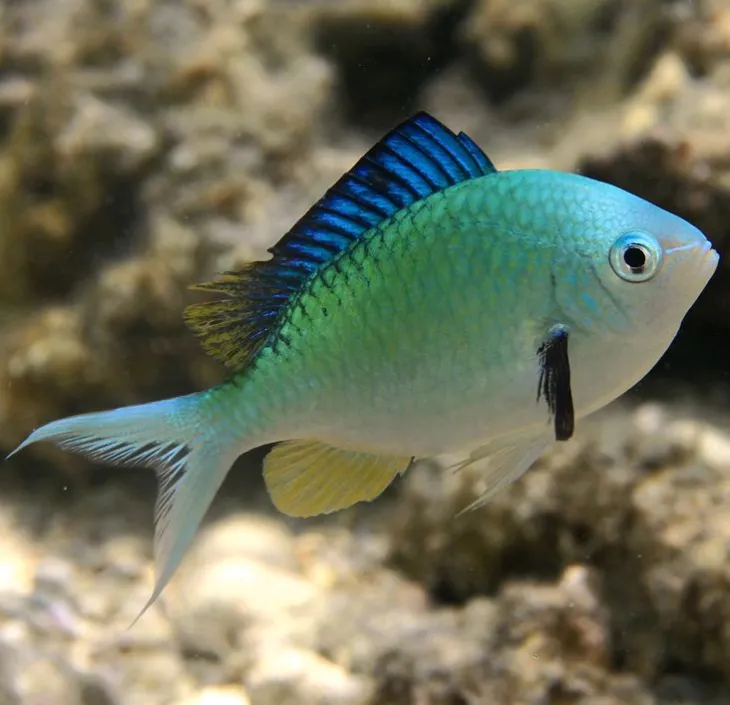
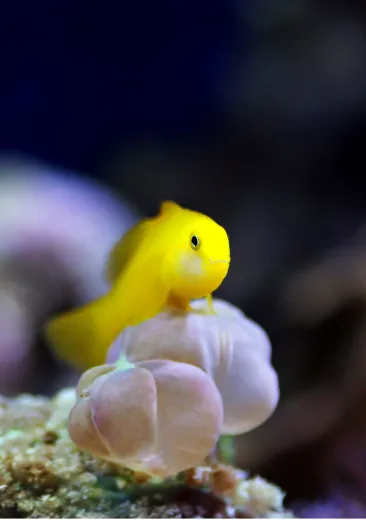
Its almond-shaped body is turquoise blue to green in colour with a forked caudal fin resembling a swallow's tail. It is therefore known as the blue damselfish, green damselfish or blue-green chromis.

The male is larger than the female.

What makes it special?

The males prepare the nest for egg laying, which is shared with several females. A large number of eggs are laid and hatch within 2 to 3 days.

The males guard the nest by fanning the fertilised eggs laid on the substrate or algae with their caudal fins and feeding on those that do not hatch.

The damselfish is born female and can change sex as it grows to become male.

Threats and protective measures

There are no specific conservation measures for this species. 

Where can I find it at Nausicaá?

Mankind and shores

The Ocean Mag

Browse through our Ocean Mag

In the spotlight

À la découverte des animaux marins avec la Voix du Nord

Pour son podcast Les ch'tites histoires, la Voix du Nord a rencontré l'équipage de Nausicaá.

Article

10 things you need to know about coral

Coral, the planet's largest builder, is a fragile and threatened animal.

Article

Why don't young fish look like adults?

In some tropical fish, the changes between birth and adulthood are so great that it is difficult to identify the young.