The latter, insensitive to the stinging properties of the anemone, feeds it with its excrement but can also feed it voluntarily.
Without the presence of clownfish in their tentacles, some bubble anemones do not have swollen tips.

Corals
Identity card
Red Sea and Indo-Pacific.
From 0 to 40 metres deep.
40 cm in diameter when fully grown.
Small invertebrates and zooplankton.
The anemone lives in symbiosis with a clownfish, which can take shelter in its tentacles.
The latter, insensitive to the stinging properties of the anemone, feeds it with its excrement but can also feed it voluntarily.
Without the presence of clownfish in their tentacles, some bubble anemones do not have swollen tips.
This anemone is found in the Red Sea and the Indo-Pacific from East Africa to Australia, Micronesia, Melanesia and Japan. It is also found in New Caledonia.
This anemone is often deeply embedded in crevices, with only its swollen tentacles visible. It is found on reef flats and reef slopes at depths of up to 20 metres. It is a ubiquitous species, found from the coastline to the outer slope.
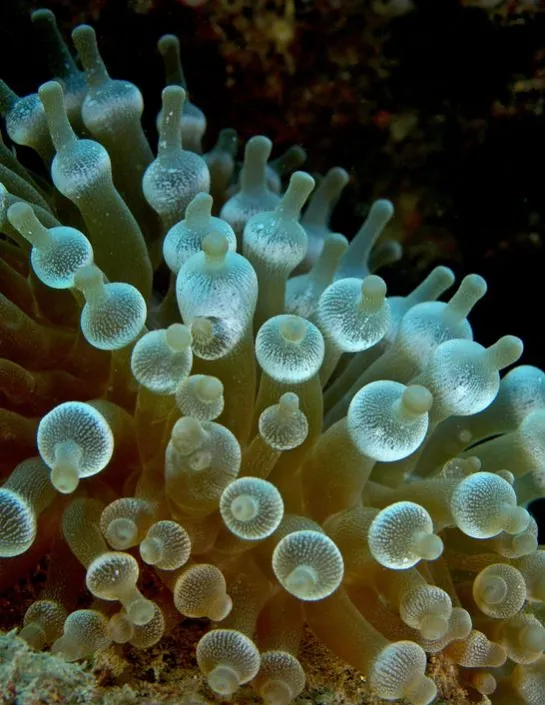
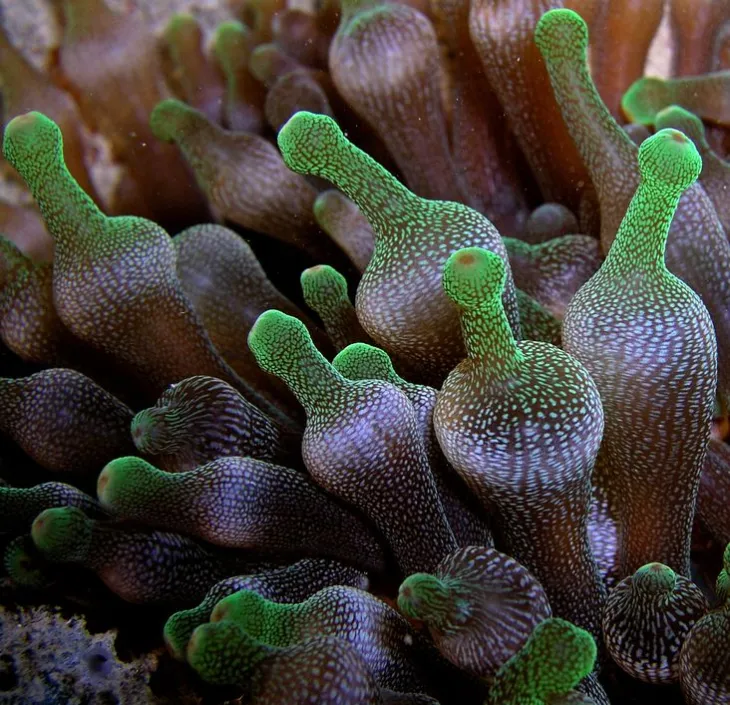
This species of anemone is characterised by tentacles measuring around ten centimetres, ending in a bulbous swelling shaped like a bulb or teat. The tentacles are generally brown, but the tips vary in colour, ranging from pink and purple to red and green.
This animal species belongs to the cnidarians, like jellyfish and corals. Its stinging tentacles enable it to capture small invertebrates and zooplankton. Like coral, it contains zooxanthellae in its tissues, which provide part of its food through photosynthesis.
Adult anemones are solitary and live at greater depths, while young individuals are grouped in colonies at shallower depths. The presence of zooxanthellae in their tissues implies a need for light.
Sexual reproduction occurs through the simultaneous release of male and female gametes, and the eggs already contain zooxanthellae. In aquariums, anemones often reproduce asexually by dividing into two separate individuals.
Mankind and shores

The Ocean Mag
In the spotlight
Ovipare, vivipare ou ovovivipare, les requins ne se reproduisent pas tous de la même façon.
Article
Une arrivée bénéfique pour la population de requins gris à Nausicaá.
Article
A new El Niño event, described as “very strong”, is set to occur from this spring onwards.