Where can I find the animal?
It is found in the Indo-Pacific, the Persian Gulf, the Red Sea and East Africa, north to southern Japan.
How can you recognise it?
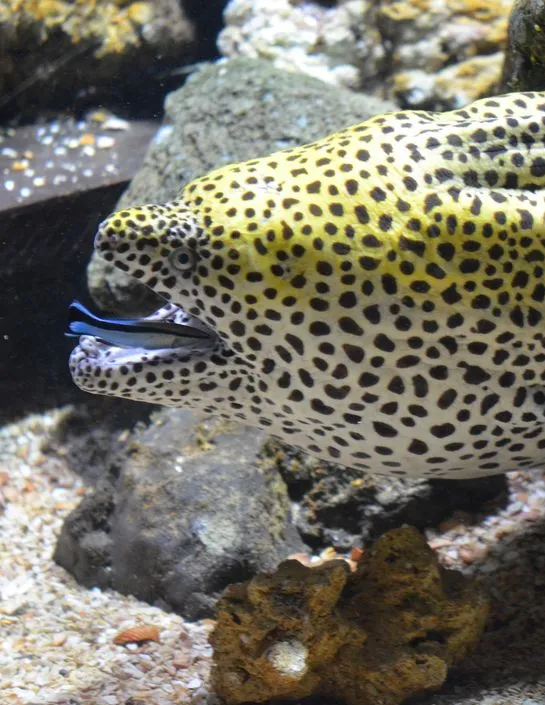
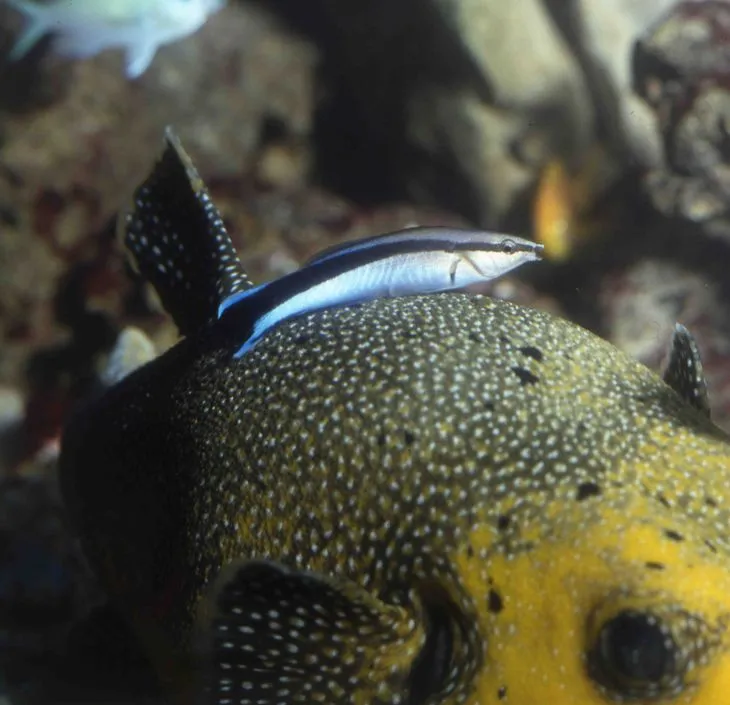
It is characterised by a long, tapered body, blue in colour with a black line running along its length, from mouth to tail.
Its small mouth is protractile and equipped with several rows of small, sharp teeth.
Its colouring and behaviour are recognised by other fish, which do not consider it as potential prey but as a 'service provider'.
What makes it special?
Solitary during its juvenile period, it then lives in groups or pairs as an adult.
All individuals are born female.
It is a fish that lives in a harem with a dominant male surrounded by females and juveniles. When the male dies, the dominant female takes his place after completing her transformation, which takes 14 to 18 days.
It is a monandrous species, meaning that the female mates with only one male.
It feeds only on parasites found on its neighbours. It therefore needs the presence of other fish to survive. It can clean up to 2,000 fish per day.
Threats and protective measures
There are no specific conservation measures for this species.