This relationship benefits both species: the pistol shrimp maintains the burrow while the goby, which has better eyesight than its partner, keeps watch.

Tropical reef fish
Identity card
Western Pacific Ocean, Japan.
Between 10 and 40 metres deep.
From 4.7 to 6 cm.
Small prey (crustaceans, worms, fish, etc.).
The goby lives in symbiosis with the pistol shrimp (Alpheus randalli), with which it shares a burrow.
This relationship benefits both species: the pistol shrimp maintains the burrow while the goby, which has better eyesight than its partner, keeps watch.
The term "yasha" in the scientific name of the goby refers to a traditional female demon in Japan; it refers to the large vomerine teeth of this goby, which are located on the palate in the fish's mouth.
The orange-striped goby lives on the seabed, near the sandy hole that serves as its burrow, at depths of between 10 and 40 metres.
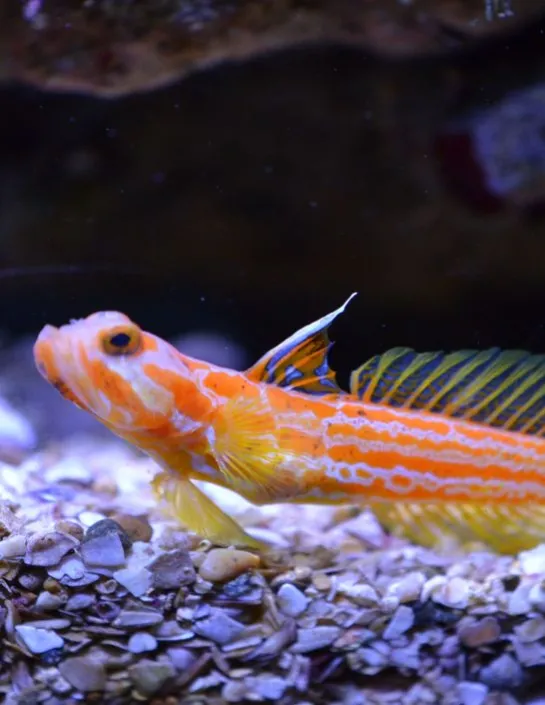
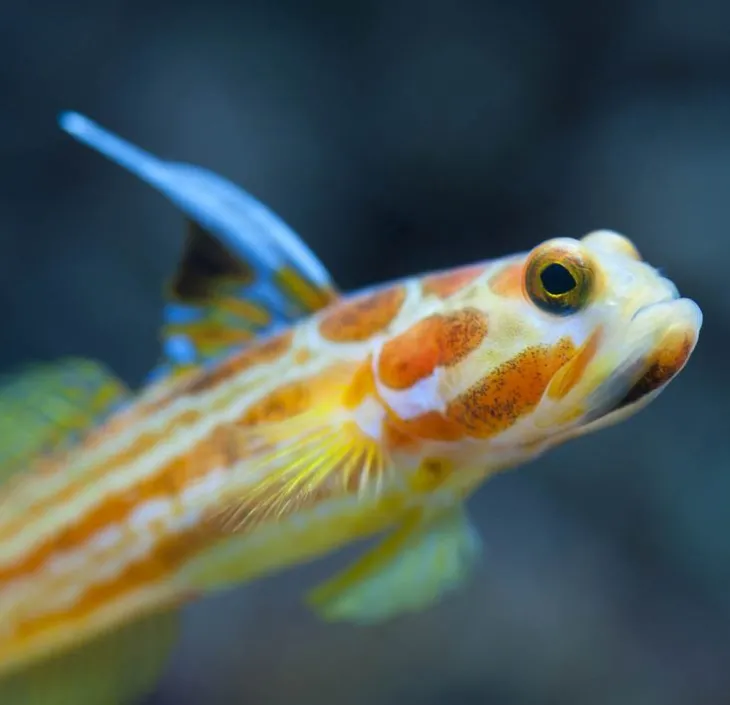
This small fish is characterised by a white body with three orange-red stripes.
Its first dorsal fin is extremely long and white in colour.
This species is easily distinguished from other congeners by the presence of orange-red stripes on a white body and only two median cephalic sensory pores on the head.
Found mainly on the outer slopes of reefs, it often lives in pairs above the sandy bottom, at the entrance to its burrow.
It has a symbiotic relationship with a pistol shrimp (Alpheus randalli). It quickly retreats into its burrow when danger approaches, thereby warning the shrimp, whose vision is poor compared to that of the goby.
There are no specific conservation measures for this species.
Mankind and shores
The Ocean Mag
In the spotlight
Ovipare, vivipare ou ovovivipare, les requins ne se reproduisent pas tous de la même façon.
Article
Une arrivée bénéfique pour la population de requins gris à Nausicaá.
Article
A new El Niño event, described as “very strong”, is set to occur from this spring onwards.