Identity card

Fire goby

Scientific name:
Nemateleotris magnifica
Family:
Microdesmidae
Class:
Actinopterygii
Phylum:
Chordata
Year of description:
Fowler, 1938
IUCN Status:
Least Concern
Distribution:

Indo-Pacific.

Habitat:

From 6 to 61 metres.

Size:

6 cm.

Diet:

Zooplankton: copepods and crustacean larvae.


Although it is called a fire goby, it does not belong to the goby family.

Guillaume, head of the tropical sector

It belongs to the Microdesmidae family. It has an elongated, slender body with a large, upright dorsal fin, whereas gobies are more stocky and often have pelvic fins that are fused into a sucker.

This fire goby is often seen in open water, swimming above the substrate, whereas gobies are mainly benthic, living on the bottom.

Did you know?

Where can I find the animal?

It is found in the Indo-Pacific region: from East Africa to the Hawaiian, Marquesas and Pitcairn Islands, north to the Ryukyu Islands, south to New Caledonia and the Austral Islands, and throughout Micronesia.

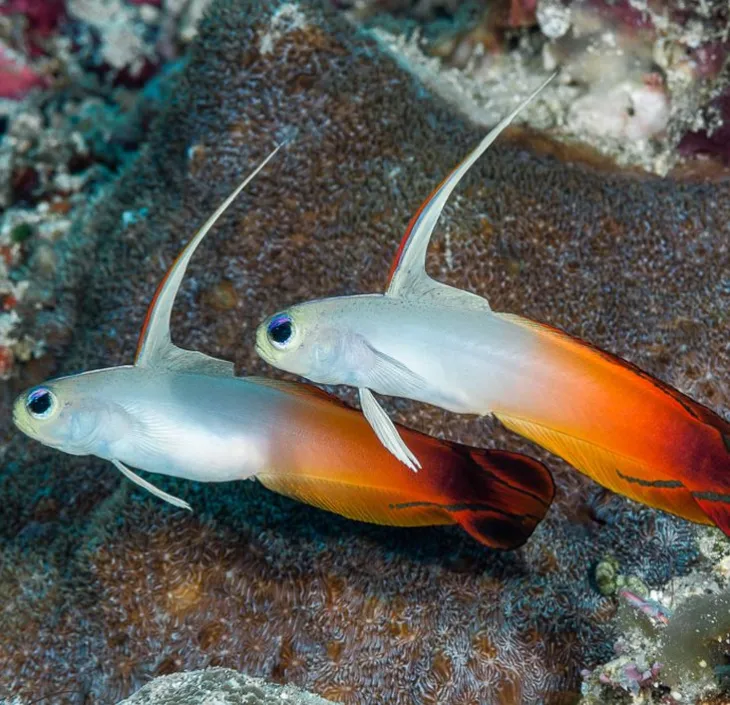
It lives above the seabed, facing the current to capture the zooplankton it feeds on (copepods, crustacean larvae).

How can you recognise it?

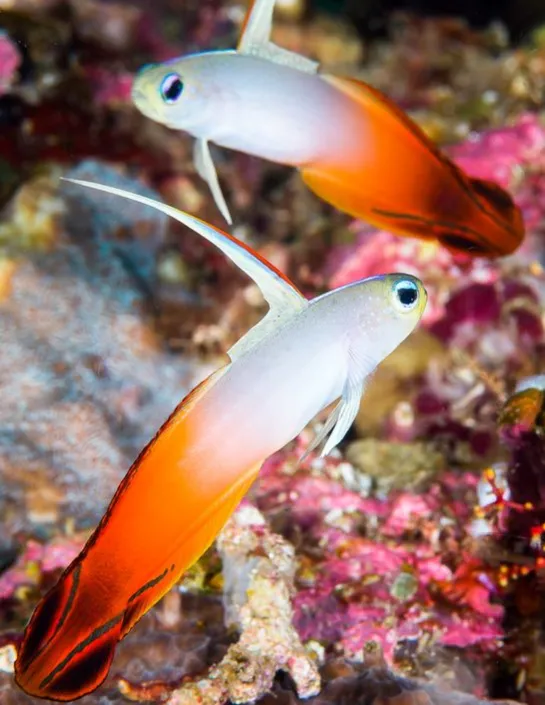
The fire goby is characterised by its elongated, two-coloured body. The front of its body is white, while the rear is red. Its first dorsal fin is fan-shaped and moves back and forth.

What makes it special?

It lives in pairs in the burrow they have created. A shy species, it stays close to its refuge. The eggs are laid in the burrow and guarded by the male until they hatch.

When young, several individuals may share the same burrow.

Threats and protective measures

There are no specific conservation measures for this species. The degradation of coral reefs may have an impact on this species at the local level.

Where can I find it at Nausicaá?

Mankind and shores

The Ocean Mag

Browse through our Ocean Mag

In the spotlight

À la découverte des animaux marins avec la Voix du Nord

Pour son podcast Les ch'tites histoires, la Voix du Nord a rencontré l'équipage de Nausicaá.

Article

10 things you need to know about coral

Coral, the planet's largest builder, is a fragile and threatened animal.

Article

Why don't young fish look like adults?

In some tropical fish, the changes between birth and adulthood are so great that it is difficult to identify the young.