Where is the animal to be found?
- The Bluespotted Lagoon Ray is commonly found in an area stretching from South Africa to Papua New Guinea, as well as Malaysia and Indonesia. It is also found in the Red Sea, Tanzania and Madagascar.
- According to the IUCN, the increase in the Taeniura lymma population in South-East Asia is linked to a reduction in the presence of sharks due to overfishing.
- The Bluespotted Lagoon Ray is a benthic fish that lives on coastal reefs to a depth of 50 m, preferring caves and ledges during the day.
- A nocturnal animal, it hunts in groups, lying in wait or swimming above the seabed, in shallow waters to find its food when the tide comes in.
How can it be recognised?
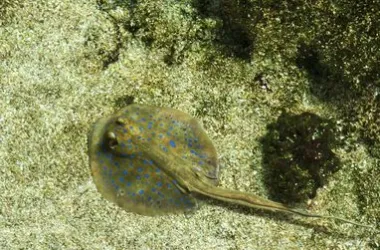
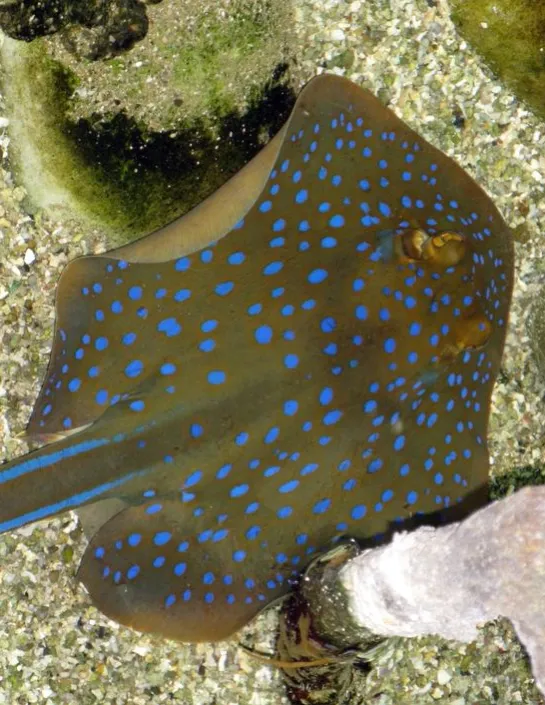
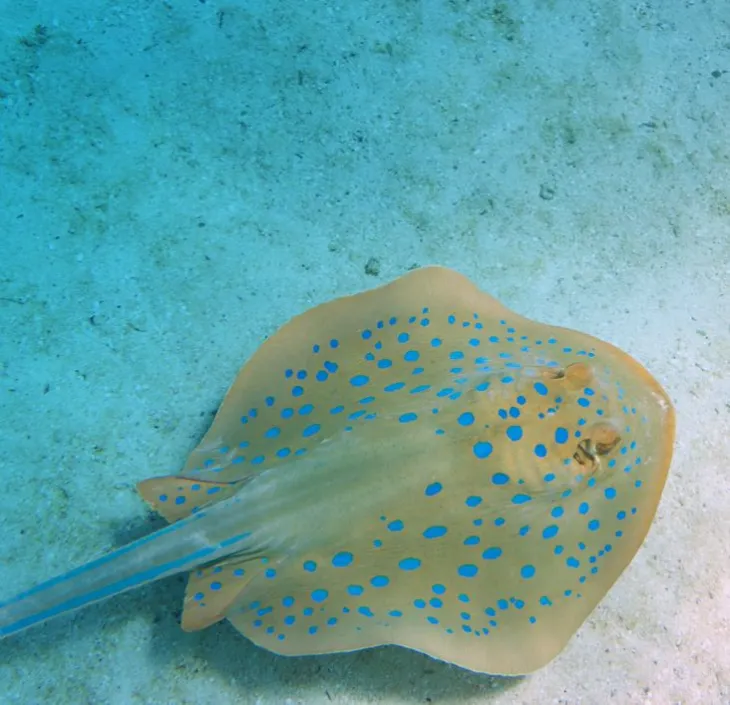
- With its yellowish back marked with blue spots, this stingray is easily recognisable. Its belly is generally white.
- Its body is disc-shaped and flattened, and its maximum disc width is 35 cm.
- The mouth and nostrils are on the belly. On its back are the eyes, located on the top of the head, and the air vents that allow it to breathe and prevent it from absorbing sand.
- Like other stingrays, it has venomous spines at the base of its tail, which is longer than its body. The stings are replaced regularly.
What is distinctive about it?
Males reach sexual maturity when their disc is 20 cm wide; the size at maturity of females is not known.
Bluespotted Lagoon Rays reproduce by aplacental viviparous means. The eggs hatch and the baby stingrays develop in the female's body. They measure 13 cm across at birth.
Threats and protective measures
The Bluespotted Lagoon Ray is vulnerable to habitat degradation, particularly the destruction of coral reefs and pollution of coastal areas.
Commonly caught by fisheries operating on shallow coral reefs, it is probably affected by dynamite fishing. Its flesh is widely consumed.