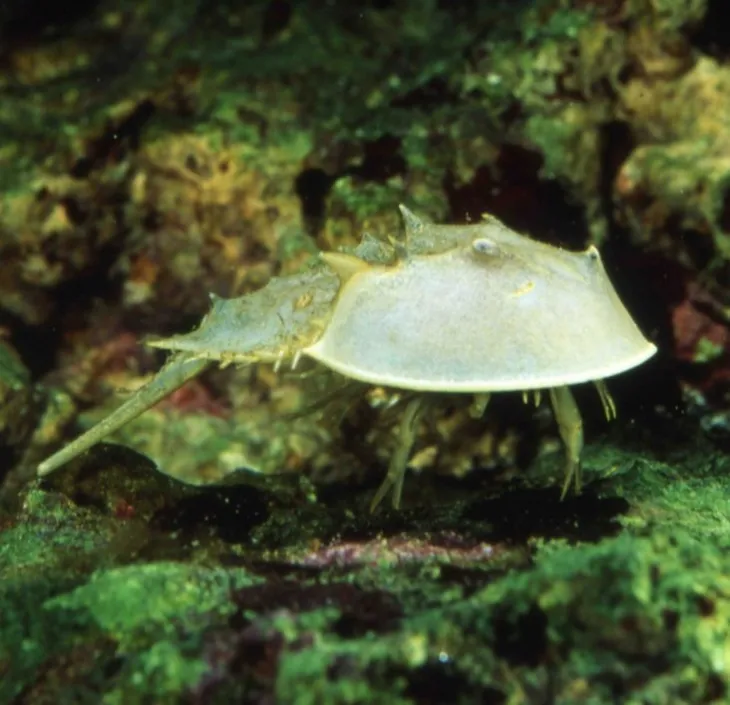
American Horseshoe Crab

  Arthropods or shellfish

Identity card

American Horseshoe Crab

Scientific name:
Limulus polyphemus
Family:
Limulidae
Class:
Merostomata
Phylum:
Arthropods
Year of description:
Linnaeus, 1758
IUCN Status:
Vulnerable
Distribution:

Atlantic coast of the United States, from Maine to Florida.

Habitat:

Estuaries or coastal lagoons, between 1 and 11 m.

Size:

Up to 70 cm (with tail).

Diet:

Marine worms, molluscs, crustaceans.

Longevity:

20 to 30 years old.


Horseshoe crabs' blood is blue due to the presence of a copper-rich protein called haemocyanin.

In the presence of certain bacteria, the horseshoe crab's blood coagulates and forms a clot that encloses the bacterial infection.

This particularity is of interest to the medical sector, which uses its blood cells to detect the presence of bacteria on surgical material and in vaccines, for example.
Did you know?

Where is the animal to be found?

Present from Nova Scotia to the Gulf of Mexico, the largest population of American horseshoe crabs is found on the north-east coast of the United States, in Delaware Bay.

The horseshoe crab is found mainly on muddy or sandy bottoms, at depths of less than 30 m.

How can it be recognised?

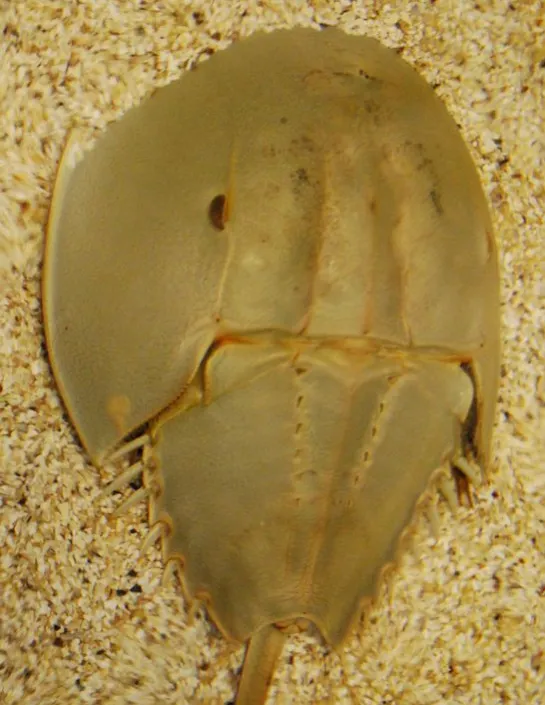
  • The horseshoe crab is an ancient arthropod, more closely related to spiders and scorpions than to crabs, despite its nickname of "horseshoe crab".
  • Its body is protected by a rigid horseshoe-shaped carapace, which it can change 15 times during moults, until it reaches adulthood.
  • It has a long, rigid tail, called a telson, which it uses to straighten up or turn over if it finds itself on its back.
  • Females are larger than males.
  • The horseshoe crab has 10 eyes, some of which are highly sensitive to ultraviolet light, a toothless mouth, 5 pairs of jointed legs to move around and a pair of appendages to guide food towards its mouth.

What is distinctive about it?

  • The horseshoe crab has survived several mass extinctions and has evolved very little over the last 450 million years. It is sometimes referred to as a living fossil.
  • Horseshoe crabs reproduce once a year, at the start of summer and on a full moon day. The females lay up to 80,000 eggs in a nest on the beach. The males then fertilise the eggs, which are buried in the sand. After incubating for 28 days, the horseshoe crab larvae return to the sea at the highest tide after the full moon.

Threats and protective measures

  • American horseshoe crabs are commercially exploited and most of the catches are used as bait for eel and whelk fisheries in the USA.
  • Harvesting by the biomedical industry for the production of Limulus amebocyte lysate (LAL) is significant and increasing, but does not result in certain mortality as is the case for bait. (Source: IUCN)

Where can I find it at Nausicaá?

Mankind and shores