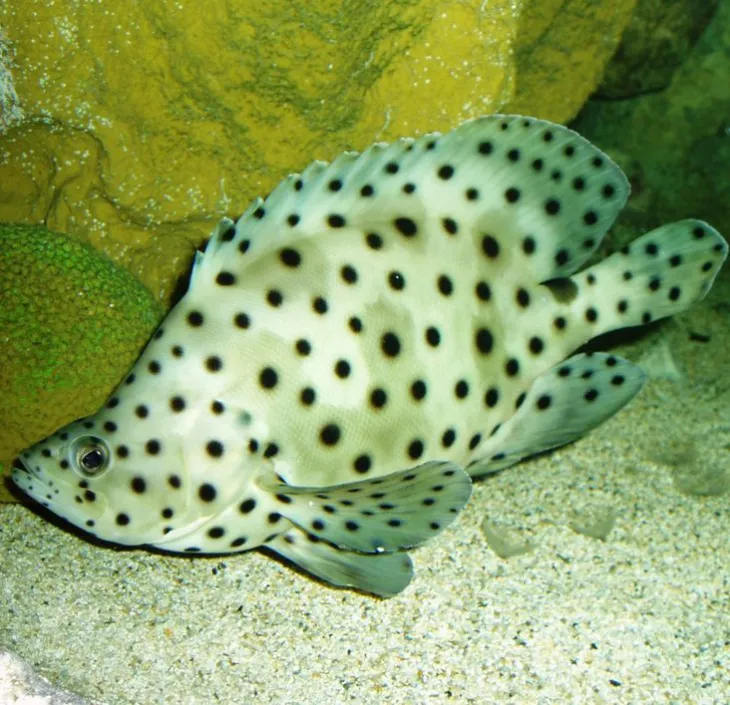
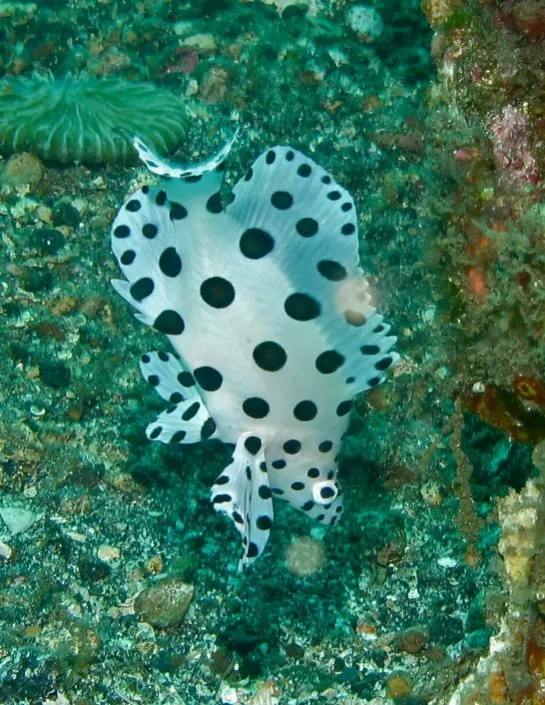
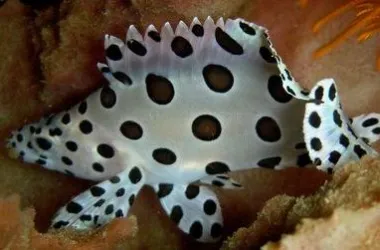
The characteristic dots on its coat are larger in the juvenile stage, but more numerous when the grouper reaches adulthood.
Where is the animal to be found?
This grouper lives between 2 and 40 m.
How can it be recognised?
- This grouper has a humped appearance with a tapered snout. With its high, laterally compressed body and tapered snout, it gives the impression of being hunchbacked.
- It is distinguished by a black-spotted coat on a greenish-brown to very light grey background in adulthood. Juveniles have a white coat.
- The dorsal fin is very high and the pectoral fins are very large.
What is distinctive about it?
- As juveniles, humpback groupers often stand upside down and move forward with strong undulations.
- A solitary species, groupers come closer together during the breeding season, which takes place at the time of the new moon. After fertilisation, the eggs are pelagic.
- This grouper also has the particularity of changing sex from female to male. It can reproduce as a female when it reaches a size of 30 to 40 cm, which corresponds to an age of 1 to 2 years.
- It is an incredible stalking hunter.
Source : JEGLOT Samuel, LIBERT François in : DORIS, 10/02/2017 : Cromileptes altivelis (Valenciennes, 1828), https://doris.ffessm.fr/ref/specie/2437
Crédit photos : Steve Childs, CC BY 2.0, via Wikimedia Commons; Udo Schröter, CC BY-SA 3.0, via Wikimedia Commons; Bernard DUPONT from FRANCE, CC BY-SA 2.0, via Wikimedia Commons;