Where can I find the animal?
This fish is found in the tropical waters of the Indo-Pacific, particularly from the Red Sea and East Africa to the Tuamotu Islands and French Polynesia, including southern Japan, Australia and New Zealand.
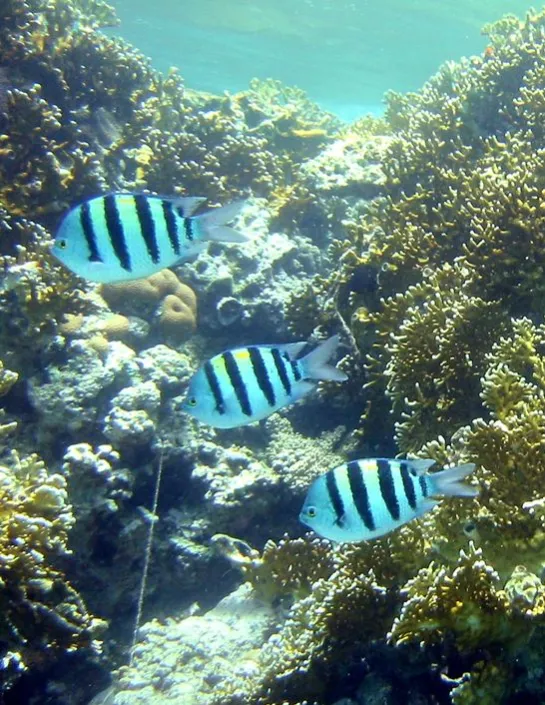
It frequents coral reefs, outer reef slopes and rocky coastal areas up to a depth of 15 metres. Juveniles are associated with floating algae.
How can you recognise it?
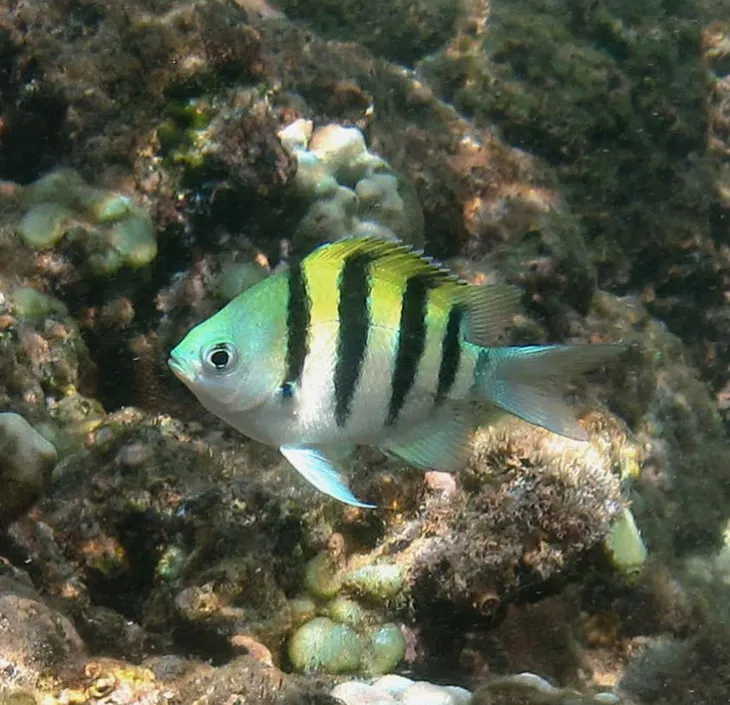
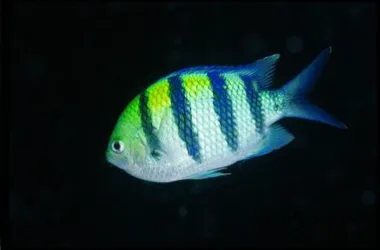
The Indo-Pacific sergeant major fish has five vertical black stripes on its sides and a yellow spot on its upper body. The first stripe is located just behind the head and the fifth on the caudal peduncle. This striped pattern is probably what gives it its name, "sergeant major fish".
Its oval, laterally compressed body is blue-green in colour with silvery to white flanks.
What makes it special?
During the breeding season, fish gather in groups at spawning sites. The polygamous male prepares a nest on a flat surface and attracts the female with a courtship dance. The female lays her eggs, which are fertilised by the male. He jealously guards them until they hatch, aerating the eggs stuck to the substrate.
The breeding season, which is synchronised with the spring tides, allows the pelagic larvae to head out to sea.
Threats and protective measures
Although classified as "Least Concern" by the IUCN, the Abudefduf vaigiensis sergeant major fish is vulnerable to coral reef degradation due to climate change, pollution and overfishing.
No specific conservation measures are currently in place.
Sources :
Crédit photos : BEDO (Thailand), CC BY-SA 4.0 via Wikimedia Commons; Photo2222, CC BY-SA 3.0 via Wikimedia Commons; Sébastien Stradal for MDC SeaMarc Maldives, CC BY-SA 4.0 via Wikimedia Commons; Philippe Bourjon, CC BY-SA 3.0 via Wikimedia Commons;