Where is the animal to be found?
- This eastern Pacific species is distributed from the Gulf of California in the north to the Peruvian coast in the south.
- Populations can be found in the Galapagos Islands (Ecuador), the Revillagigedo Islands (Mexico), Malpelo Island (Colombia) and Cocos Island (Costa Rica).
- It is found in rocky and coral reefs at depths of between 1 and 80 m.
- It feeds on sessile invertebrates, algae and plankton, but is more specialised in sea sponges.
How can it be recognised?
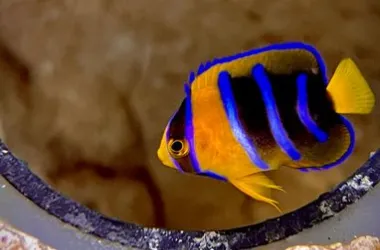
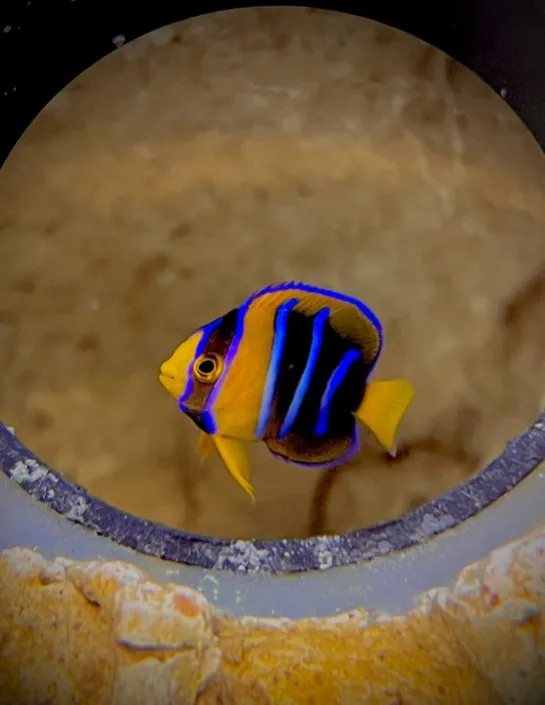
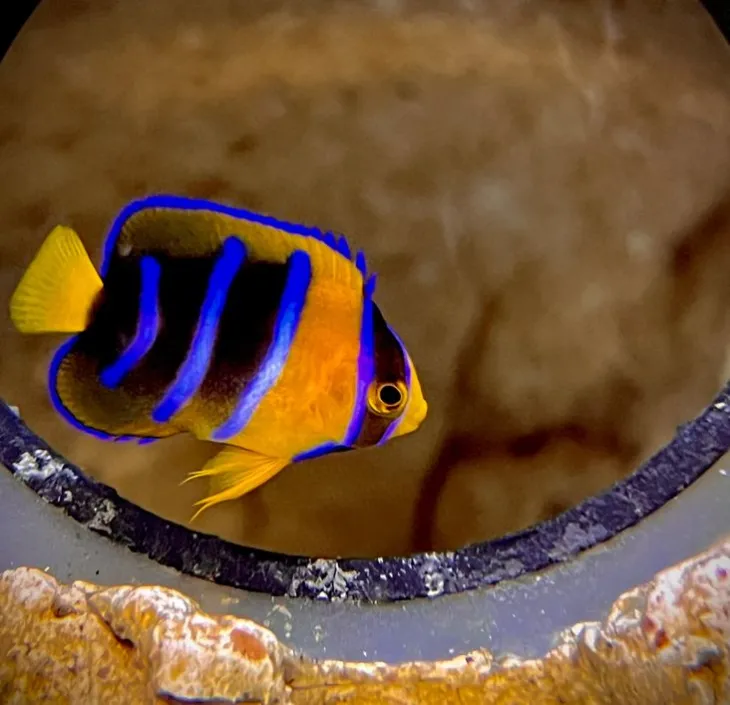
- These fish show a marked colour dimorphism between juveniles and adults: the latter have a dark blue to brown body with a vertical white band in front of the head, and yellow pectoral and caudal fins. Juveniles are orange to bright yellow with blue stripes and fins edged in iridescent blue.
What is distinctive about it?
- Females are more territorial and form pairs with males.
- Adults clean parasites from sharks. Cleaning behaviour has been observed in juveniles.
- Reproduction takes place at the end of the summer, with daily spawning throughout the lunar cycle.
Threats and protective measures
- Although classified as 'Least Concern' by the IUCN, Holacanthus passer is vulnerable to disturbances to coral reefs, such as pollution, overfishing and extreme climatic events like El Niño.
- No specific conservation measures are currently in place.