Blackback Anemonefish

Blackback Anemonefish

  Tropical reef fish

Blackback Anemonefish

Identity card

Blackback Anemonefish

Scientific name:
Amphiprion frenatus
Family:
Pomacentridae
Class:
Actinopterygii
Phylum:
Chordata
Year of description:
Brevoort, 1856
IUCN Status:
Least Concern
Distribution:

North-West Pacific and East Asia.

Habitat:

Anemonefish are the only fish that can live in contact with the venomous tentacles of sea anemones.

Size:

It can measure up to 14 cm.

Diet:

The Anemonefish is omnivorous. It likes to eat small crustaceans such as tubifex, artemia, cyclops, or daphnia.

Blackback Anemonefish
 

Every individual is initially male, before growing up and (eventually) turning into a female

Did you know?

The Anemonefish is omnivorous. It likes to eat small crustaceans such as tubifex, artemia, cyclops, or daphnia. In a couple, the female is always larger than the male. 

Where is the animal to be found?

This very colourful fish lives in close proximity to sea anemones. 

How can it be recognised?

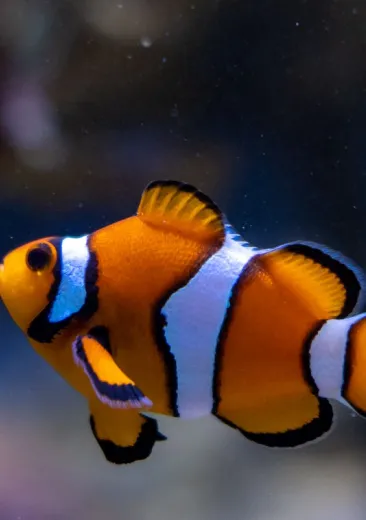
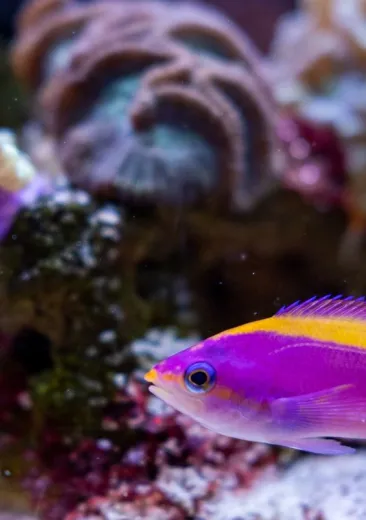
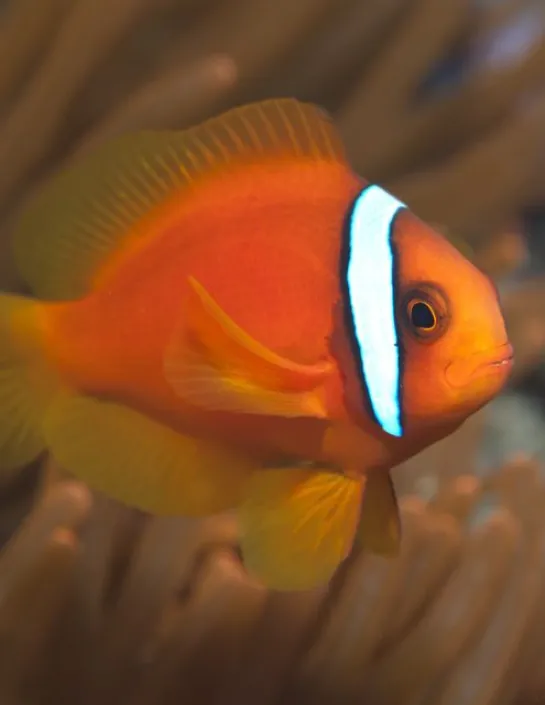
The blackback anemonefish is one of the most colourful anemonefishes. Juveniles have two white stripes, whereas adults have only one stripe on their head. It can measure up to 14 cm.

What is distinctive about it?

Anemonefish are the only fish that can live in contact with the venomous tentacles of sea anemones. They provide them with protection from predators.
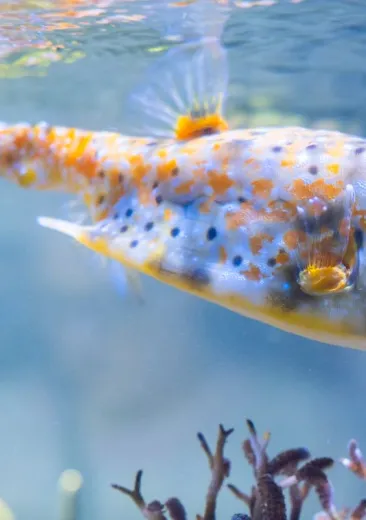
Tropical reef fish

The Ocean Mag

Browse through our Ocean Mag

In the spotlight

Nausicaá à la COP31 : faire entendre la voix de l’océan

À l'occasion de la COP31, Nausicaá contribuera à plusieurs événements internationaux consacrés au lien entre océan et climat.

Article

COP31 sur le climat : une conférence de l’action ?

La 31e Conférence des Parties sur le climat se déroulera en Turquie du 9 au 20 novembre 2026.

Article

Nausicaá à la COP17 : faire une place à l’océan dans les engagements pour la biodiversité

Nausicaá est présent à Erevan pour suivre les discussions de la COP17 et contribuer à faire entendre les enjeux liés aux écosystèmes marins.