Biodiversity 4mn
Egg stories, reproduction strategies in marine animals
Which came first, the egg or the fish? A brief overview of eggs and reproductive strategies in marine animals.

Fish eggs, penguin eggs, shark and ray eggs... At Nausicaá, thousands of eggs are laid each year, resulting in several hundred births within the aquarium.
But what does a ray egg look like? Do sharks lay eggs? Do fish take care of their eggs? Is reproduction necessarily sexual? How does the Nausicaá team of carers collect fish eggs? What happens to them? Are fish bred at Nausicaá?
Here are some answers!
Eggs galore
The most common mode of reproduction in fish is oviparous, meaning that fish lay eggs. In the Journey on the high seas tour, for example, thousands of eggs are laid. In fish and corals, males and females release their sex cells – eggs and sperm – in a synchronised manner, and fertilisation occurs randomly.
This strategy of numbers ensures the survival of species that live in schools, such as sardines, which can lay up to 60,000 eggs. Their eggs are pelagic, meaning they float on the surface like plankton and are preyed upon by other species that feed on them.
The parents reproduce but do not care for their offspring.
Overprotective parents
A nest for laying and incubation
In other species, the eggs are benthic, meaning that they settle and remain on the bottom thanks to a sticky substance that attaches them to a rock.
The females lay eggs that are fertilised by the males.
Clownfish lay their eggs on a flat surface and oxygenate them by flapping their fins during incubation. In the case of the royal gramma, a small two-coloured tropical fish, the males prepare the nesting site. They guard the eggs until they hatch while maintaining the nest.
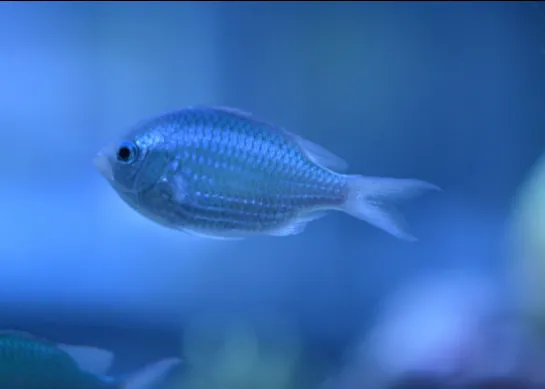
Males are equally involved in the blue-green damselfish Chromis viridis. They prepare the nest for spawning, which is shared with several females. A large number of eggs are laid and hatch within 2 to 3 days.
The male ballan wrasse builds the nest with seaweed, and the eggs laid by the female immediately attach themselves to it.
And in the case of the wolf eel, the male and female take turns surrounding the eggs to protect them.
Among the African penguins
Penguins reproduce sexually and fertilisation occurs internally. Couples that have laid eggs incubate them for 40 days and then care for their baby penguin for several weeks. If a couple has laid two eggs, they may entrust one of them to another couple, who will care for it as if it were their own.
Father figures
In certain species of fish, the male actively participates in the survival of his species and the incubation of his eggs.
In fact, it is the male seahorse that carries the eggs laid by the female in its pouch and gives birth to the baby seahorses.
The Banggai apogon, meanwhile, keeps the eggs in its mouth during incubation, during which time it cannot feed.
The same is true of the male arowana that lives in the Submerged Forest area of Nausicaá; it keeps the fertilised eggs in its mouth, which serves as a shelter for the juveniles.
Shark and ray eggs
Sharks and rays are not so cautious!
After mating, females of certain species of sharks and rays lay eggs, which are keratin capsules in which the embryo develops.
The incubation period varies depending on the species of shark, ranging from approximately four months for zebra sharks to twelve months for leopard sharks.
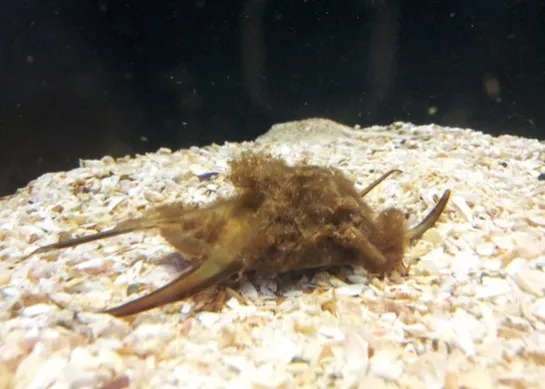
The same is true for thornback skates, undulate rays and dogfish, where females lay rectangular-shaped eggs.
The horns present at each corner of the egg make it possible to distinguish and identify species of rays, whereas it is very difficult to recognise a species of fish from its egg!
What do the Nausicaá carers do with all these eggs?
At Nausicaá, aquarists collect eggs from various tanks in the aquarium and incubate them in aquarium reserves. After hatching, the teams monitor the fish's growth until they reach a size that allows them to be transferred to the various exhibition areas.
Thus, Atlantic Lookdowns (Selene vomer) as well as Orbiculate batfish (Platax orbicularis), sardines (Harengula clupeola), grunts (Haemulon sp) and palometa (Trachinotus goodei), as well as royal trevally (Gnathanodon speciosus) and common blue-striped snappers (Lutjanus kasmira) have been born in our reserves.
By developing the breeding of certain species, Nausicaá is committed to preserving biodiversity.
Learn more about reproduction
Other articles
How do fish sleep?
Biodiversity 3mn
No eyelids, no sleep? Fish need rest too.
Do all fish have scales?
Biodiversity 3mn
Scales or no scales? Do all fish have them?
Why don't fish sink?
Biodiversity 3mn
What is the secret that prevents fish from sinking to the bo...