Biodiversity 3mn
Do all fish have scales?
Scales or no scales? Do all fish have them?

Remember, as a child, when you drew a fish with precision. While the fish's triangular tail was necessarily covered with straight lines, its body was covered with rounded, tile-shaped scales that you took care to colour one by one.
But in nature, do all fish have scales? Not necessarily!
Scales: natural armour
Scales are small plates that cover the dermis, a layer of skin, of certain animals to protect them. They are found on turtles, reptiles such as snakes and lizards, certain insects such as butterflies... and, of course, fish.
In bony fish, scales are clearly present. They protect the skin from parasites, improve hydrodynamics and reduce friction, but they are not all identical.
- Cycloid scales are smooth and rounded. They have growth rings that reveal the age of the fish. Sardines, herrings and salmon have these scales.
- Ctenoid scales have fine serrations on their edges, which improve the animal's hydrodynamics. These are the scales of wrasses, groupers, parrotfish and butterflyfish.
- Finally, ganoid scales are hard and shiny, similar to enamel or bone plates. They are characteristic of certain species such as sturgeon and boxfish. Sturgeon scales are arranged in rows, while the body of the boxfish is covered with a rigid shell.
Other species have distinctive scales: the sunfish has thick, rough skin with scales that resemble armour. The arapaima, a large fish from the Amazon, has scales several centimetres thick, hard on the outside and soft on the inside, and their exceptional resistance to attacks from predators such as piranhas has attracted researchers, who are using them as inspiration to produce resistant materials.
Fish without scales
The smooth skin of certain fish
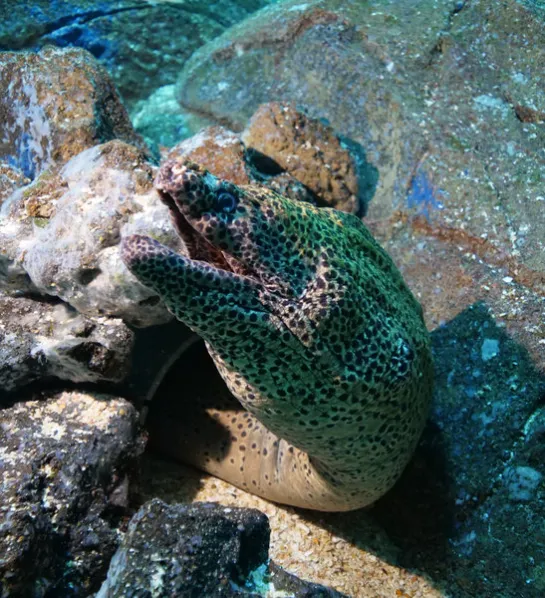
In eel-like fish, such as moray eels, eels and conger eels, the scales are tiny and buried under the skin. Their skin is smooth and covered with mucus, which protects them from both predators and parasites and allows them to glide more easily through the water.
This near absence of scales gives them a flexibility suited to their lifestyle and their ability to slip into cracks and crevices.
In the deep sea, fish live in extreme conditions and are subjected to high pressures. A rigid body could not withstand this. This is why hagfish have a soft, gelatinous body with a skeleton of low bone density, capable of withstanding the pressure of the deep sea.
Among sharks?
Sharks and rays, which are cartilaginous fish, do not have scales, but rather denticles composed of dentine and enamel, like teeth. The skin of sharks is rough and promotes the hydrodynamics of these selachians.
This characteristic has been studied and exploited by researchers to design coatings designed to improve the aerodynamics of aeroplanes or the hydrodynamics of swimsuits, optimising swimmers' performance.
Can scales be recycled?
After recycling mussel shells and scallop shells, fish scales can be crushed and turned into a durable, solid material for making splashbacks and floor tiles.
So, scales or no scales, is fish a source of inspiration?
Other articles
Why don't fish sink?
Biodiversity 3mn
What is the secret that prevents fish from sinking to the bo...
How do fish sleep?
Biodiversity 3mn
No eyelids, no sleep? Fish need rest too.
What is the fastest fish in the world?
Biodiversity 3mn
With a speed of up to 100 km/h, the Indo-Pacific sailfish is...