Biodiversity 3mn
What is the fastest fish in the world?
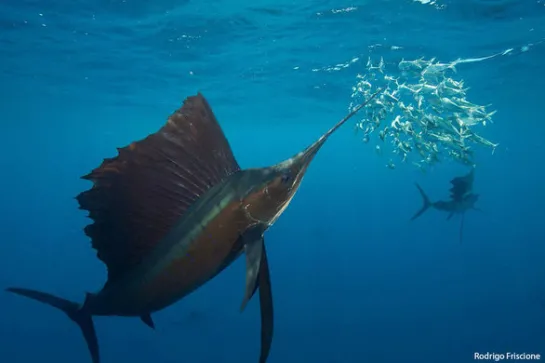
With a speed of up to 100 km/h, the Indo-Pacific sailfish is the fastest fish in the world.

The sailfish Istiophorus platypterus is capable of travelling at speeds of up to 100 km/h! This makes it the fastest fish in the world.
So how did it reach this speed? Could it have exceeded the speed limit in the waters it frequents? The sailfish was not flashed by radar, but this speed record was recorded during a fishing catch, when the fish unwound 91 m of fishing line in 3 seconds! Impressive, isn't it?
Where can I find the animal?
The sailfish swordfish is an oceanic, epipelagic fish (i.e. at a depth of between 0 and 200 metres) that usually lives at a depth of between 0 and 10 metres, mainly in waters close to coasts and islands, in water temperatures of between 21 and 28°C.
Sometimes found in shoals or small groups spread over a wide area, sailfish group together by size.
They are found in tropical and temperate waters of the Pacific, Indian and Atlantic oceans. They can also be seen in the Mediterranean Sea on their way up from the Red Sea through the Suez Canal.
What does it eat?
The sailfish eats fish, crustaceans and cephalopods. It has a habit of chasing schools of fish by knocking them out with its rostrum.
How do you recognise it?
With its fin in the shape of a sail and its very fine beak that adds good hydrodynamic capacity, the sailfish is easily recognisable. A highly migratory fish, its body is designed to travel like that of its close relatives, the mackerel and tuna.
Its body is a midnight-blue colour with vertical stripes down the sides. Its belly is pale with a silvery sheen.
Females are generally larger than males and Pacific sailfish have been found to be larger than Atlantic sailfish.
What makes it special?
This fish is migratory and travels to the Pacific Ocean to reproduce. It reproduces during the summer seasons in the tropical and subtropical waters of the area where it is found.
During the breeding season, males and females pair up or several males pursue a female.
Threats and protection measures
This highly migratory species is listed in Annex I of the 1982 Convention on the Law of the Sea (FAO, Fisheries Department, 1994). It is also classified as a vulnerable species on the IUCN red list.
This species is often a by-catch but is also targeted by certain fisheries. It can be eaten fresh or smoked, and is used in sushi.
It is also prized by sport fishermen, which could be a threat to this species, which is found close to the coast and near islands.
Photos by Michael Worden on Unsplash, NOAA
Other articles
What is the largest turtle in the world?
Biodiversity 4mn
At two metres long and weighing up to 500 kg, the leatherbac...
What is the world's largest jellyfish?
Biodiversity 3mn
With 800 tentacles sometimes measuring 30 metres and an umbr...
Which fish is the largest in the world?
Biodiversity 4mn
At up to 18 metres in length, the whale shark is the largest...