Biodiversity 4mn
Which fish is the largest in the world?
At up to 18 metres in length, the whale shark is the largest of all fish.

Is the whale shark a fish? Yes, it is a cartilaginous fish, the only member of the Rhincodontidae family. It is the largest fish in the world, ranging in size from 5 to 12 metres, and sometimes reaching 15 - 18 metres - that's more than the length of a bus!
This pelagic selachian, which can live up to 80 years, is a placid animal. It moves slowly and is harmless to humans.
A record-breaking fish, it can filter up to 6,000 litres of water an hour and swallow a tonne of food a day. This is hardly surprising given that the whale shark can weigh up to 30 tonnes!
Where can you find it?
A large pelagic fish, the whale shark Rhincodon typus is found in all tropical, temperate and warm seas except the Mediterranean. It lives in the Atlantic Ocean, from New York to Brazil and from Senegal to the Gulf of Guinea, in a large part of the Indian Ocean and also in the Pacific Ocean.
It is often accompanied by tuna and mackerel, other pelagic fish with which it undertakes long migrations.
It moves between the surface and a depth of 120 m, but can also dive to a depth of 1,000 m. It can be found in lagoons, near estuaries or river mouths at times when fish and invertebrates proliferate, providing the basis of its diet.
What does it eat?
It feeds mainly on plankton, algae and microscopic animals, as well as small fish.
How does it feed? Filter its food while swimming or stand motionless in the middle of a shoal of fish for a better catch. It then swallows large quantities of water which it empties through its gills, which act like a sieve to retain the food.
How do you recognise it?
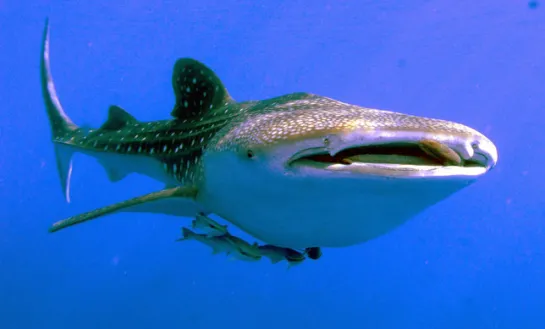
The whale shark can be recognised by its massive body marked by three large transverse lines and five vertical gill slits located above the pectoral fins. These gills allow the shark to breathe but also filter the water it absorbs in large quantities when it eats.
Its back is a bluish-grey colour. It is dotted with white dots and lines forming a checkerboard pattern, while its belly is a light, solid colour. This distribution of dots and lines helps to identify sharks: each coat is unique.
This shark can also be recognised by its flat head and large mouth, which varies in width from 1.50 m to 2 m.
Although it is the largest fish in the world, it is smaller than the blue whale, which at 25 metres is the largest mammal in the animal kingdom!
Sunfish are the heaviest bony fish, weighing in at 2 tonnes and measuring 2 to 3 metres in length.
What makes it special?
The whale shark remains a mysterious animal, and little is known about its reproduction. We don't know where they mate, or where the females give birth. Nor do we know how long their gestation period lasts, although some suggest that they reproduce every two years.
The mode of reproduction is thought to be ovoviviparous, meaning that the eggs develop and hatch in the female's belly and she expels viable baby sharks. Sexual maturity is reached when the shark is 9 m long, at around 20 or 30 years of age.
Threats and protection measures
The late sexual maturity of whale sharks weighs heavily on the survival of the species as well as that of other sharks. It is listed as "Endangered" on the IUCN Red List, which states that 37% of sharks and rays are threatened with extinction worldwide. The whale shark is also listed in Appendix II of CITES.
The high market value of the whale shark makes it a target for Asian markets: fins and meat are consumed and it is also used in Chinese medicine. Fishing and by-catches threaten the whale shark, as do pollution and collisions with ships.
Donations to Nausicaá
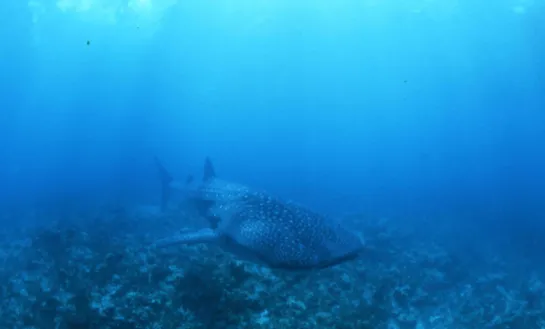
The Nausicaá Endowment Fund and the Mapelo Foundation are joining forces to carry out an ambitious conservation project to take effective action and learn more about sharks, their breeding grounds, migration routes and behaviour.
Each contribution will fund concrete actions in the field.
Other articles
How many teeth do sharks have?
Biodiversity 4mn
A shark would be a dentist's worst enemy !
What do sharks eat?
Biodiversity 4mn
The image of a voracious shark constantly on the lookout for...
Comment le requin inspire-t-il de nouvel...
Biodiversité marine 1mn
Nausicaá et Esprit sorcier vous expliquent le biomimétisme à...