Biodiversity 3mn
What is the world's largest jellyfish?
With 800 tentacles sometimes measuring 30 metres and an umbrella one metre in diameter, the lion's mane jellyfish is the largest jellyfish in the worl

The lion's mane jellyfish Cyanea capillata is the largest jellyfish in the world. With its numerous tentacles that can reach a record length of 36.6 metres, this jellyfish is larger than a blue whale!
Where can you find it?
It lives all around the Arctic Circle in the North Pacific (from Japan to California) and in the North Atlantic (in the St. Lawrence, northern United States and northern Europe).
In France, it is found in the English Channel and the North Sea.
Despite its size, the jellyfish remains a planktonic animal, meaning that it can be carried along by currents. They live in the open sea, generally between 0 and 85 metres deep, usually in the first 20 metres, but winds and currents can bring them towards the coast.
What does it eat?
It feeds on fish, crustaceans and other jellyfish, which it paralyses using the millions of cnidocytes on its tentacles, which it carries from the tentacles to its mouth.
Shrimps or small fish, juvenile mackerel, cod or horse mackerel live in the middle of its tentacles to escape their predators and take advantage of the food scraps.
The lion's mane jellyfish is also the prey of large predators: leatherback turtles and moonfish are fond of jellyfish, as are seabirds.
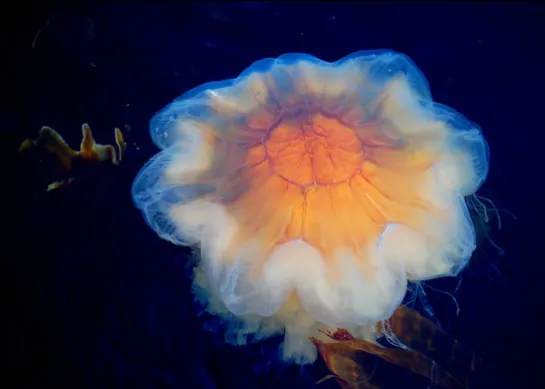
How do you recognise it?
The lion's mane jellyfish Cyanea capillata owes its name to its large number of fine tentacles that resemble hair. The Latin word ‘capillata’ means hairy.
In the middle of these tentacles (sometimes as many as 800!) are four wavy oral arms. The diameter of its bell varies from 50 to 100 cm, but in colder waters, the diameter can reach 2 metres.
The umbrella is divided into eight lobes alternating with eight rhopalia, which are the jellyfish's sensory organs.
The colour of jellyfish varies with age: young jellyfish are pink or yellow, while older ones have a darker colour ranging from red to orange-brown.
What makes it special?
The lion's mane jellyfish is highly urticating, especially individuals that have reached their maximum size, i.e. at the end of summer and autumn.
Even when washed ashore, jellyfish tentacles can continue to cause burns for several hours. This species is thought to be less dangerous near metropolitan coastlines.
Its tentacles contain millions of cnidocytes. These organs are equipped with a cilium which, upon contact with prey (or the skin of a swimmer), triggers a tiny harpoon that releases venom.
Other articles
Which fish is the largest in the world?
Biodiversity 4mn
At up to 18 metres in length, the whale shark is the largest...
Humpback anglerfish
Abyss 2mn
You've heard of it, haven't you? Undoubtedly yes if you have...
What is the largest turtle in the world?
Biodiversity 4mn
At two metres long and weighing up to 500 kg, the leatherbac...