Biodiversity 4mn
What is the largest turtle in the world?
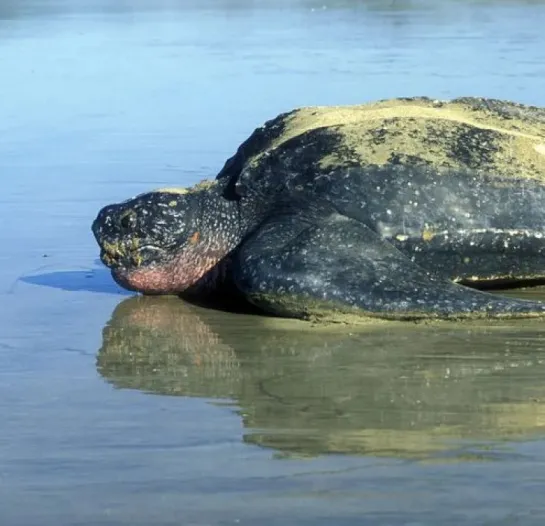
At two metres long and weighing up to 500 kg, the leatherback is the largest of the sea turtles.

The leatherback turtle Dermochelys coriacea is the largest of the sea turtles and tortoises in general.
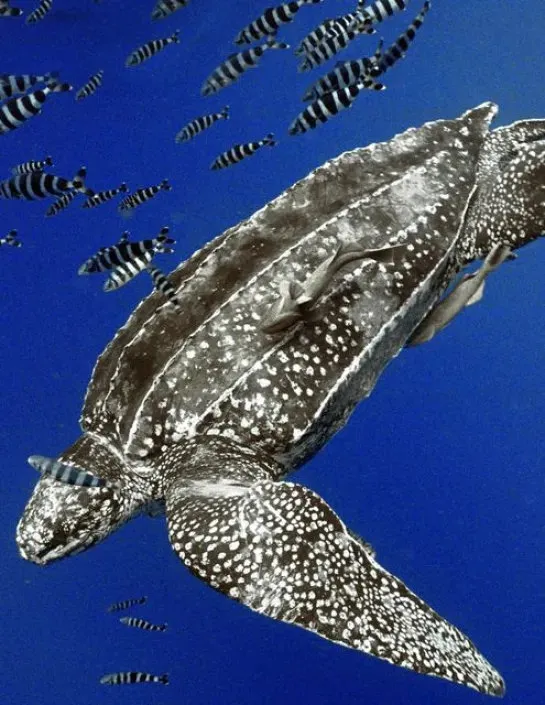
It is distinguished from its congeners by its shell, which has no scales. In fact, it is made up of a thin skin covering a thick layer of fat and seven carinae - the elements that make up the carapace - along its length.
It can grow to between 1.5 and 2 metres in length and weigh between 300 and 500 kilos!
Where can you find it?
The leatherback turtle is found throughout the world, except in the Arctic and Southern Oceans. This turtle is a pelagic animal that lives on the high seas and can dive to a depth of 1,300 m, remaining underwater for 85 minutes before surfacing to breathe.
A highly migratory species, the leatherback turtle can cover more than 16,000 km a year between its nesting sites and its search for food.
Females of reproductive age lay eggs every 2 to 4 years, always on the same beach located in tropical or subtropical areas. They lay eggs 2 or 3 times at intervals of 10 to 15 days, and each time they lay 100 to 200 eggs, which incubate for 60 to 70 days.
What does it eat?
The leatherback turtle follows the populations of jellyfish and cephalopods that make up its diet. It feasts on lion's mane jellyfish, as well as pelagic tunicates, fish, sea urchins, crustaceans, molluscs and a few algae and plants.
To satisfy their food requirements, young turtles need to consume the equivalent of their weight in jellyfish.
To retain the gelatinous bodies of the jellyfish it ingests, the leatherback turtle's mouth and throat are equipped with backward-facing spines.
How do you recognise it?
The leatherback turtle's body is 'shaped' to travel long distances with ease, and its hydrodynamic shape means it can be fast underwater, reaching speeds of up to 40 km/h.
Its movements are also aided by front flippers that are proportionally longer than those of other sea turtles, and its rear flippers are paddle-shaped.
What makes it special?
Leatherbacks can live up to 50 years and reach sexual maturity between the ages of 9 and 20. When they are born, the little turtles head out to sea, and on the way from the nest to the ocean, these 7 cm turtles are easy prey for birds, crabs and dogs, which feast on them.
Leatherback turtles' bodies have not changed since the time of the dinosaurs.
Threats and protection measures
The leatherback turtle is an endangered species, classified as vulnerable on the IUCN Red List and listed in Appendix I of CITES. In France, it has been fully protected since 2011.
Leatherback turtle populations are declining in several parts of the world, particularly in the Pacific. These turtles are under threat both on their nesting beaches and in the ocean.
Urbanisation encroaching on the coastline is reducing the area of dry sand that turtles need to lay their eggs. Street lighting disturbs them and disorients young turtles trying to reach the ocean. Turtle poaching and human consumption of eggs have an impact on the survival of the species, despite its protected status in many countries.
Rising sea levels linked to climate change are causing erosion of the beaches and therefore the area where the females come to nest. Similarly, the temperature of the sand has an impact on the survival of the eggs and on the male/female distribution, as sexual determination depends on the temperature of the nest.
In the ocean, warmer water is also having an impact on the abundance and distribution of food, causing turtles to move around more, as well as variations in the nesting season. Plastic pollution causes mortality in turtles, which mistake plastic bags for jellyfish and choke on them. By-catch in fishing nets kills turtles through drowning or injury. Collisions with boats when turtles are close to the surface.
Other articles
Which fish is the largest in the world?
Biodiversity 4mn
At up to 18 metres in length, the whale shark is the largest...
What are fish whiskers for?
Biodiversity 2mn
Barbell or vibrissus, marine animals also have moustaches!
How do fish breathe underwater?
Biodiversity 2mn
That's why fish don't blow bubbles!