Biodiversity 3mn
How do fish sleep?
No eyelids, no sleep? Fish need rest too.

While it is easy to see that the cat on the sofa is taking its third nap of the day — probably dreaming that it is chasing the neighbour's cat, that intruder — how can we tell if a fish is asleep?
Sleep in fish
Fish sleep very differently from mammals, and we refer to it more as a period of inactivity or recovery for fish than sleep as we experience it.
Even when they slow down to rest, fish remain vigilant against predators. Since they cannot lock themselves in a room for the night, they develop ingenious tactics to seek shelter and recover their energy.
Another peculiarity is that fish do not have eyelids – except for certain sharks – so how do we know that these fish are resting if they do not close their eyes?
Are all fish grey at night?
Some fish actually tone down their colours or patterns so as to remain unnoticed by potential predators. This is the case for certain tropical fish, whose bright colours become duller at night.
Others, such as wrasses, seek shelter in rocky crevices or corals. Benthic fish settle on the seabed, sometimes even hiding in the substrate.
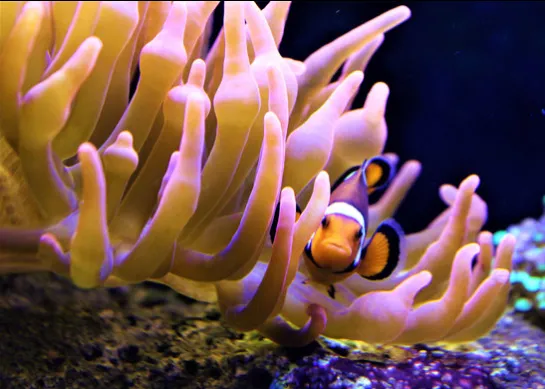
The parrotfish has developed a very special tactic: it creates a mucus cocoon that protects it from predators and masks its scent. If a predator gets too close to its mucus coating, the parrotfish is alerted and can react immediately. Clownfish prefer to stay safe within the stinging tentacles of their anemone.
Finally, sharks, which must swim constantly to breathe, slow down their pace when resting. Whitetip Reef Shark, for example, gather in groups and swim slowly in circles.
Diurnal fish, nocturnal fish
When daylight fades, some diurnal fish go to sleep, while others are perfect "night fish". Moray eels and groupers, for example, lead a rather discreet life during the day and only come out of their shelters at night to hunt.
Some nocturnal fish, such as squirrelfish, have large eyes that are adapted to low light conditions. Others, such as soldierfish, take advantage of the night to hunt for crustaceans and other invertebrates that are more active after dark.
At Nausicaá, we have noticed a change in the behaviour of the fish in the large tank of the high sea at the end of the day. Fish that live in shoals close ranks, a protective reflex towards other species, while other individuals also seem to slow down and move more slowly.
When closing time approaches, life changes pace!
Photo du poisson perroquet : Jérôme Paillet (2014). Poisson-perroquet dormant (Scarus). Ifremer.
Other articles
How do fish breathe underwater?
Biodiversity 2mn
That's why fish don't blow bubbles!
Why don't fish sink?
Biodiversity 3mn
What is the secret that prevents fish from sinking to the bo...
What is the fastest fish in the world?
Biodiversity 3mn
With a speed of up to 100 km/h, the Indo-Pacific sailfish is...