Identity card

Bowmouth guitarfish

Scientific name:
Rhina ancylostomus
Family:
Rhinidae
Class:
Chondrichthyens
Phylum:
Chordata
Year of description:
Bloch & Schneider, 1801
IUCN Status:
Critically Endangered
CITES-status:

Appendix II

Distribution:

Indo-Western Pacific.

Habitat:

Between 0 and 70 metres deep.

Size:

Between 150 and 178 cm on average in adulthood, up to 270 cm.

Diet:

Crustaceans and molluscs.

Conservation program:

Nausicaá joins the European conservation programme EEP – EAZA ex-situ programme.


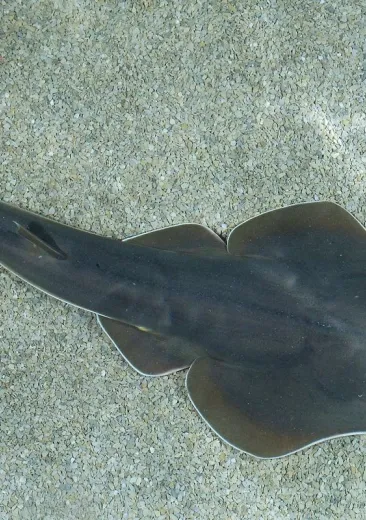
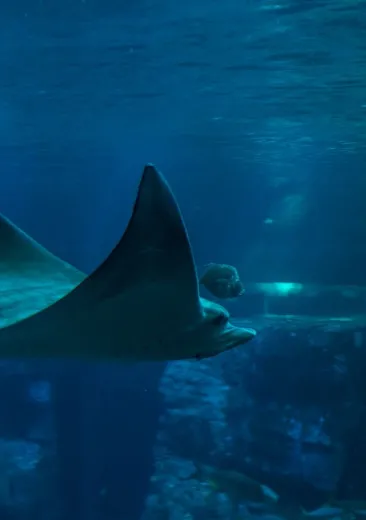
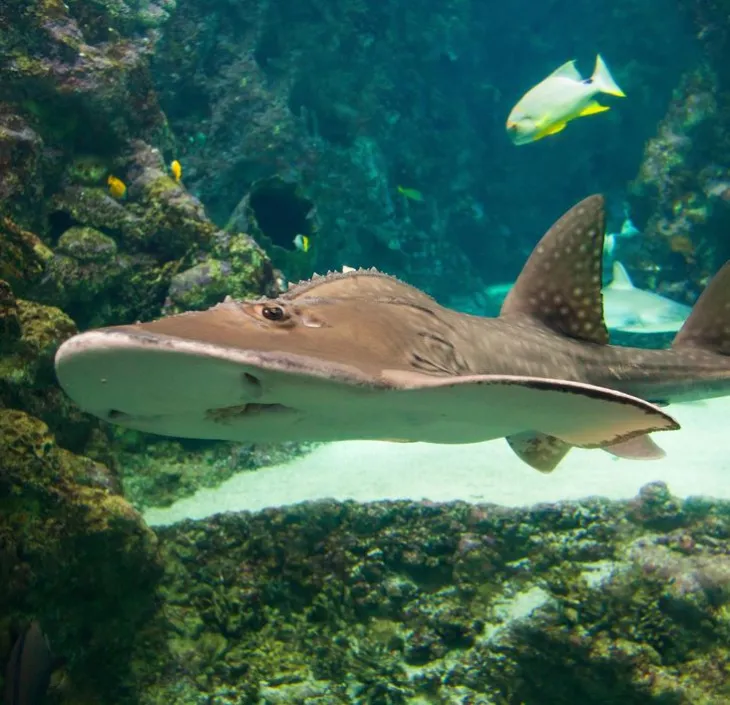
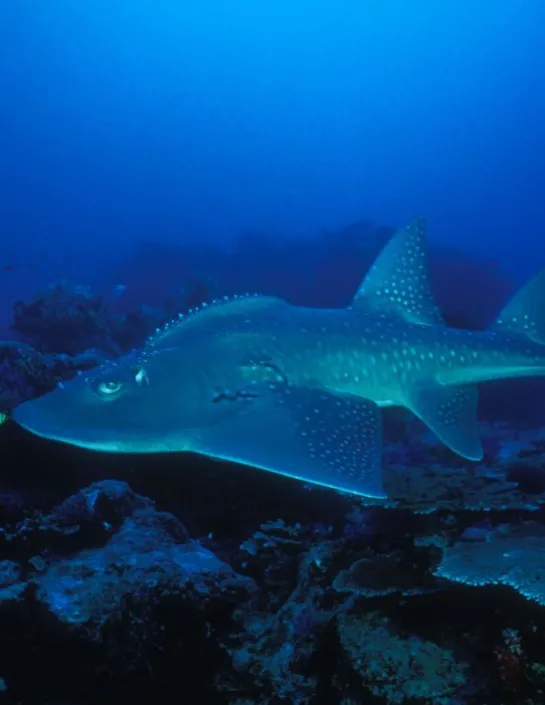
The bowmouth guitarfish has a ray-like body at the front and a rear section that resembles the shape of a shark.

Ludwig, head of the oceanic sector

The way it moves is also reminiscent of a shark's movements.
Did you know?

Where can I find the animal?

  • The bowmouth guitarfish lives in the Indo-Western Pacific from South Africa to the western Indian Ocean, the Arabian Sea, Southeast Asia, and extends north to Japan and south to Australia. It is widespread in the north of the continent and east to New Caledonia.
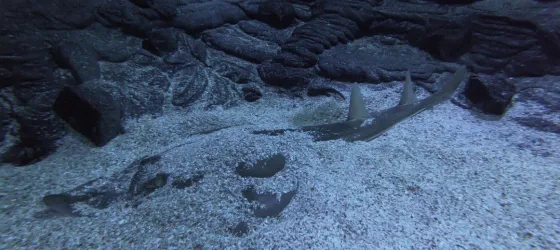
  • It lives mainly in coastal areas and coral reefs near the coast, preferably on sandy and muddy bottoms, up to a depth of 70 m. It is sometimes found in the water column.

How can you recognise it?

  • It can be recognised by its broad, rounded snout and high pectoral fins. Spines can be seen on its back, shoulders and above its eyes.
  • Its jaws are equipped with rows of striated teeth, adapted to its diet of crustaceans and molluscs.
  • Its body is grey to brown on top, its belly is white, and numerous white spots cover its fins, body and tail. Black spots can be seen on its head and upper body.

What makes it special?

  • Its mode of reproduction is aplacental viviparous, meaning that the eggs grow inside the female and hatch there before the baby guitarfish are expelled. They can measure up to 45 cm at birth.
  • Litters can number between 2 and 11 young. 

Threats and protective measures                                   

  • Sharks and rays, including wedge-shaped fish, are often targeted and heavily exploited in the Indo-Western Pacific by net and trawl fisheries for the high value of their fins.
  • Targeting of wedge-shaped fish for their fins has also been reported in many countries, including Indonesia, Malaysia, Madagascar, Mozambique, and Tanzania.
  • Habitat loss and environmental degradation also threaten the species' survival.

Source : IUCN Red List

Where can I find it at Nausicaá?

Journey on the high seas

The Ocean Mag

Browse through our Ocean Mag

In the spotlight

À la découverte des animaux marins avec la Voix du Nord

Pour son podcast Les ch'tites histoires, la Voix du Nord a rencontré l'équipage de Nausicaá.

Article

10 things you need to know about coral

Coral, the planet's largest builder, is a fragile and threatened animal.

Article

Why don't young fish look like adults?

In some tropical fish, the changes between birth and adulthood are so great that it is difficult to identify the young.