Orangeback angelfish

  Tropical reef fish

Identity card

Orangeback angelfish

Scientific name:
Centropyge acanthops
Family:
Pomacanthidae
Class:
Actinopterygii
Phylum:
Chordata
Year of description:
Norman, 1922
IUCN Status:
Least Concern
Distribution:

Western Indian Ocean.

Habitat:

From 6 to 40 metres.

Size:

Max. 8 cm.

Diet:

Invertebrates and algae.


This fish reproduces at sunset. It nibbles the female's abdomen to stimulate the release of eggs.

Guillaume, head of the tropical sector

These are released and abandoned in open water without any particular parental care.

Did you know?

Where can I find the animal?

The species is found in the western Indian Ocean. It is encountered from the east and south coasts of Africa to the Maldives, as well as in the Mozambique Channel, Madagascar, the Mascarene Islands and the Chagos Archipelago.

It is found on coral reefs and sometimes among branches or pieces of coral in areas with heavy algae growth. 

How can you recognise it?

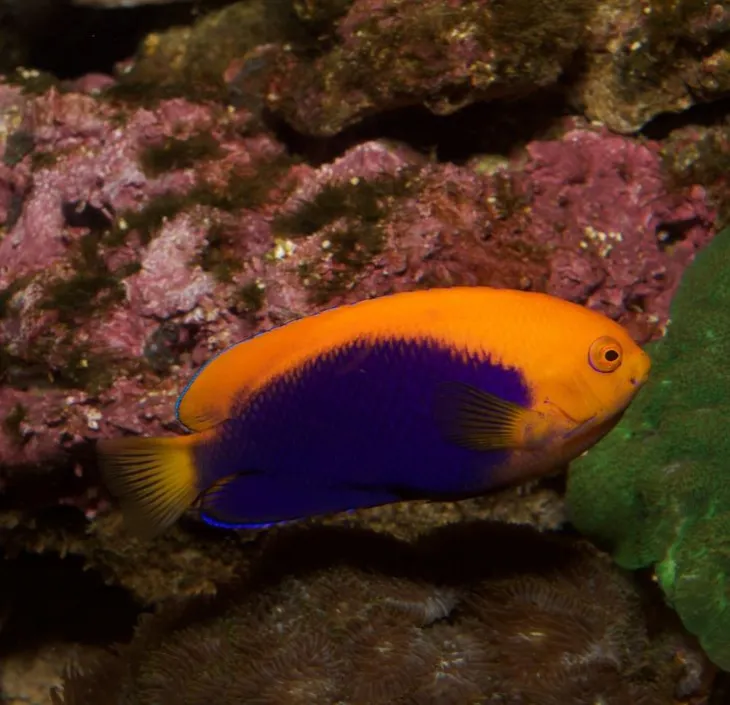
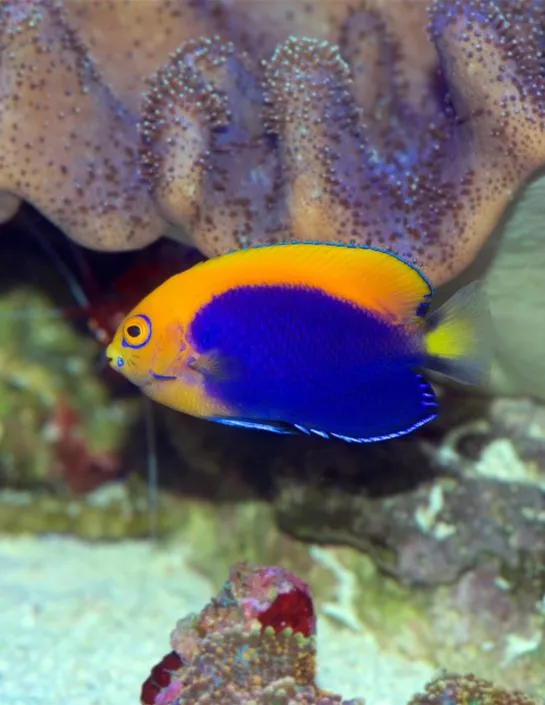
The head, upper side, dorsal and caudal fins are orange-yellow in colour, while the lower part of its body and anal fin are midnight blue with numerous closely spaced purple spots. Adult males are larger than females.

What makes it special?

Species of the genus Centropyge are protogynous hermaphrodites, meaning that females can become males depending on the social structure of the group. This species functions as a harem around a dominant male, sexually mature females – the largest of which is the dominant female – and a few immature females.

Rival males fight each other at the edge of their territory.

Threats and protective measures

There are no specific conservation measures for this species.

Where can I find it at Nausicaá?

Mankind and shores

The Ocean Mag

Browse through our Ocean Mag

In the spotlight

À la découverte des animaux marins avec la Voix du Nord

Pour son podcast Les ch'tites histoires, la Voix du Nord a rencontré l'équipage de Nausicaá.

Article

10 things you need to know about coral

Coral, the planet's largest builder, is a fragile and threatened animal.

Article

Why don't young fish look like adults?

In some tropical fish, the changes between birth and adulthood are so great that it is difficult to identify the young.