Spotted boxfish

  Tropical reef fish

Identity card

Spotted boxfish

Scientific name:
Ostracion meleagris
Family:
Ostraciidae
Class:
Actinopterygii
Phylum:
Chordata
Year of description:
Shaw, 1796
IUCN Status:
Least Concern
Distribution:

Indo-Pacific and Eastern Pacific.

Habitat:

Between 1 and 30 metres deep.

Size:

Maximum length: 25.0 cm

Diet:

Sponges, molluscs, copepods and algae.


It can produce toxic mucus on the body when stressed.

In this species, a neurotoxin produced by bacteria is present in large quantities in the liver, viscera and gonads, but is also found in the skin.

Females are more toxic than males, due to the high concentration of TTX (tetrodotoxin) in their ovaries.

Where can I find the animal?

It is found in the Indo-Pacific and eastern Pacific regions: from East Africa to Mexico, north to southern Japan and the Hawaiian Islands, and south to New Caledonia and the Tuamotu Islands.

The spotted boxfish lives in clear lagoons and reefs on the sea side, down to at least 30 metres. Juveniles are found among rocky blocks, often with long-spined sea urchins, and adults on reef ridges and slopes. 

How can you recognise it?

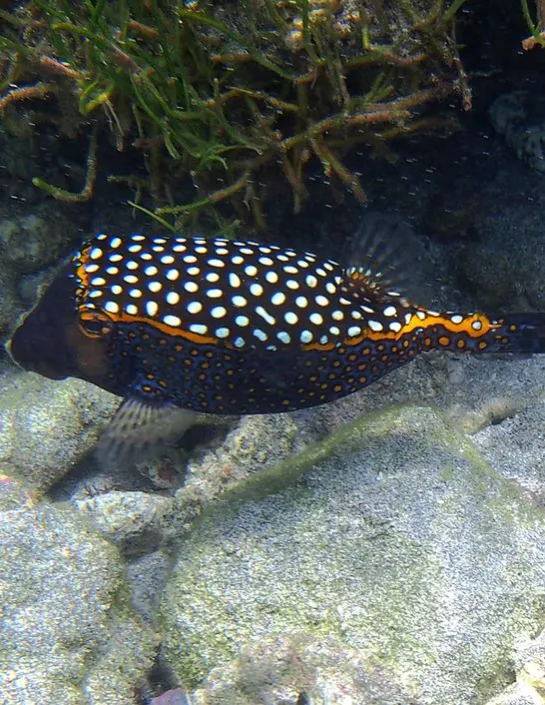
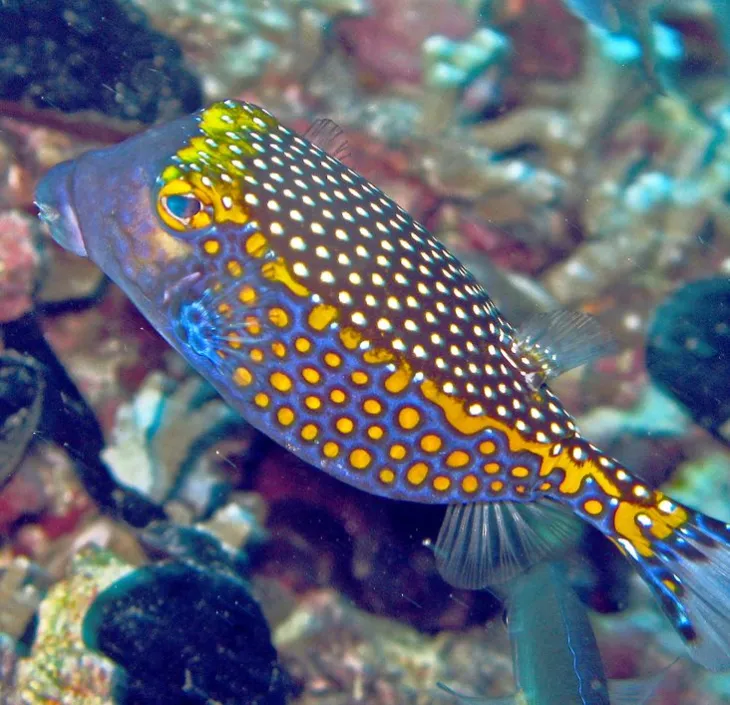
The females have black bodies with white spots; the males, which are larger, have blue bodies with black upper bodies, white spots, and a yellow line.

It is these white spots that give it the name guinea fowl chestnut fish.

What makes it special?

Its trapezoidal box-shaped body is typical of boxfish. Its rigid body is covered with bony plates.  

It is born female and becomes male as it grows.

It is a solitary fish.

Threats and protective measures

There are no specific conservation measures for this species.


The Ocean Mag

Browse through our Ocean Mag

In the spotlight

À la découverte des animaux marins avec la Voix du Nord

Pour son podcast Les ch'tites histoires, la Voix du Nord a rencontré l'équipage de Nausicaá.

Article

10 things you need to know about coral

Coral, the planet's largest builder, is a fragile and threatened animal.

Article

Why don't young fish look like adults?

In some tropical fish, the changes between birth and adulthood are so great that it is difficult to identify the young.