An oviparous fish, the female spotted ratfish produces up to 30 eggs per year, laid at the rate of two per fortnight during the breeding period which runs from the end of the spring to the autumn.
They remain attached to the female for several days once they have been expelled from her body. Once the link is broken, the eggs fall and sink into the seabed in the upright position for an incubation period lasting about 12 months. The young are 14 cm long at birth.
How can you recognise them?
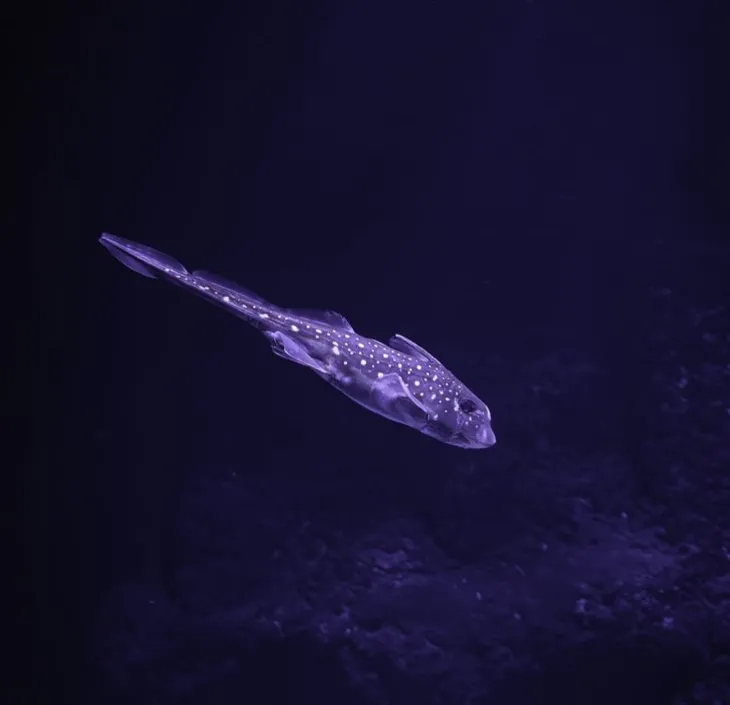
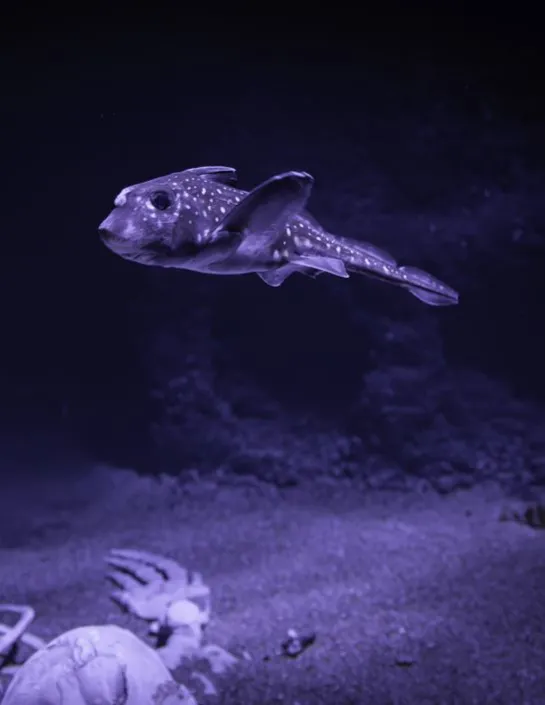
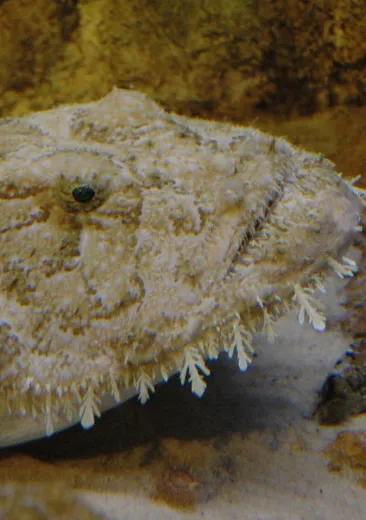
- Spotted ratfish are characterised by a short round snout and a small mouth with visible solid teeth that allow them to crush their prey.
- The body is reddish with white spots, and like the moray eel it does not have scales.
- The female is larger than the male and can grow to a length of 1 metre. The tail represents half its body length.
Its large pectoral fins serve as a powerful motor. It flies through the water like a bird through the air.
Where can it be found?
The spotted ratfish lives in temperate waters at temperatures of between 7 and 9 °C – maximum 12 °C. It can usually be found at depths of between 50 and 400 m but it can descend to a depth of 900 m to look for food.
It lives near the seabed in silty and rocky habitats.
The spotted ratfish lives in the north-east Pacific, from the west coast of North America, down to Baja California, Mexico, including the Gulf of California, and Costa Rica. As you go down towards the south of its distribution area, the spotted ratfish is found at gradually greater depths.
What is distinctive about them?
The spotted ratfish has a venomous spine on its dorsal fin. This barb, which the ratfish uses as a defensive mechanism, causes painful lesions in humans, but can be fatal for harbour seals, one of the ratfishes’ predators and which feed on them.
Like rays and sharks, they are cartilaginous fishes. But unlike sharks whose teeth are renewed all their life long, the spotted ratfish has solid dental plates which allow them to crush the crustaceans and molluscs that constitute their basic diet, and which they hunt mainly at night.
They detect their prey using their sense of smell and electroreception.
Threats
This species is not targeted by the fisheries, but it is caught as by-catch by the commercial trawler and long-line fisheries and is only rarely kept. In Oregon the trawlers use devices to avoid by-catches and reduce the pressure exerted on the fish populations.