Giant isopod

Giant isopod

  Arthropods or shellfish

Giant isopod

Identity card

Giant isopod

Scientific name:
Bathynomus doederleini
Family:
Cirolanidae
Class:
Malacostraca
Phylum:
Arthropoda
Year of description:
Ortmann, 1894
IUCN Status:
Not Evaluated
Distribution:

Japan, Taiwan, Philippines

Habitat:

Lives in the abyssal depths down to - 2,300 m.

Size:

About 20 cm.

Diet:

Mainly a scavenger, also feeds on fish and cephalopods.

Giant isopod
 

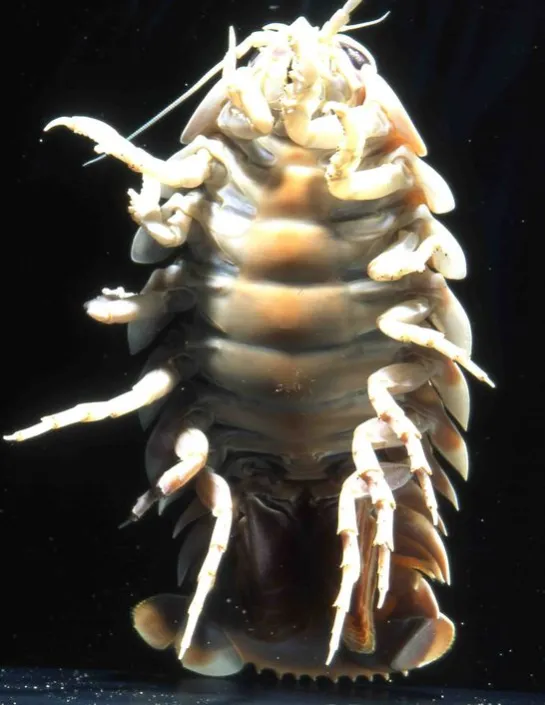
The giant isopod looks like and is related to the woodlouse! It is a crustacean, of the order isopoda.

It therefore has seven pairs of legs of the same appearance, and unstalked eyes. It weighs approximately 1 kg for a length of 30 cm.

Did you know?

Where can you find them?

The giant isopod is a benthic species that lives on the continental slope. They can be found at depths of between 310 and 2,300 m over a sandy or detrital seabed.

The isopod is a deep-sea species that can be found off Japan, Taiwan and the Philippines.

How can you recognise them?

  • Isopods look like woodlice and are a brown to purplish-grey colour.
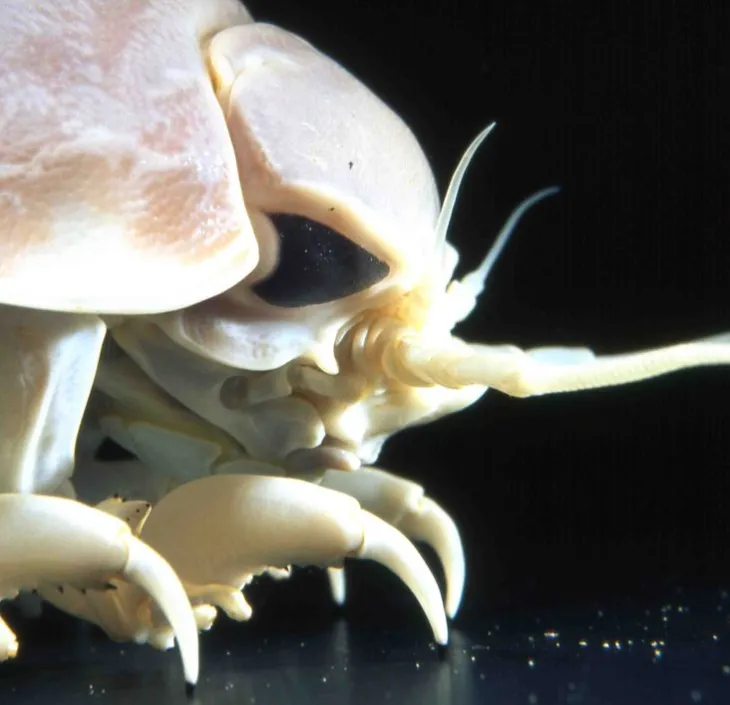
  • Their head is topped by two pairs of antennae and their jaws have four pairs of mandibles.
  • They are about twenty centimetres long.

Their exoskeleton consists of:

  • Jointed segments that form a solid carapace,
  • Head fused with the first thoracic segment,
  • The first pair of thoracic appendages are called maxillipeds and are used for mastication. Their mouth can cut and swallow large pieces of food.
  • Seven pairs of uniform legs, hence the name isopod.
  • Five pairs of swimming paddles called pleopods that are used by the females to carry their eggs.
  • The telson forms a broad tail shield that has between 12 and 14 terminal spines.

What is distinctive about them?

  • They are carnivorous, scavengers and saprophagous, that is to say they eat the detritus that arrives in the form of an organic snowfall on the seabed.
  • They can survive for a long time without eating.
  • Isopods have been brought up accidentally in fishing nets still alive, unlike other deep-sea species which cannot withstand the decompression.
  • The ecology of these deep-sea animals is very poorly known as they are difficult to study in situ.
  • This species is increasingly being sought after by fisheries because its flesh is of the same quality as that of crabs and lobsters.

Where can I find it at Nausicaá?

Journey on the High Seas

The Ocean Mag

Browse through our Ocean Mag

In the spotlight

Le saviez-vous ? Les coulisses de la reproduction à Nausicaá en 2025

Poissons, crevettes, requins, les animaux qui se reproduisent ou sont élevés à Nausicaá rejoignent les espaces d'exposition.

Article

Egg stories, reproduction strategies in marine animals

Which came first, the egg or the fish? A brief overview of eggs and reproductive strategies in marine animals.

Article

10 things you need to know about coral

Coral, the planet's largest builder, is a fragile and threatened animal.