As a fish approaches, it opens its mouth and sucks in its prey. You name it, they can eat it: fish, crustaceans and even sea birds.

Cold and temperate sea fish
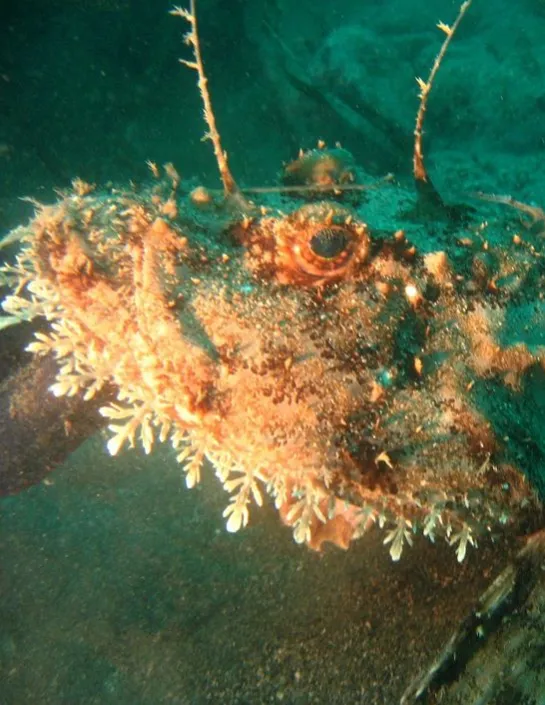
Identity card
Atlantic Ocean, Mediterranean and Black Sea.
Between depths of 20 and 1,000 m, and even deeper.
Average of 1 m, 2 m maximum (record for a male).
Mainly fish (pout, horse mackerel, ray, conger eels, etc.).
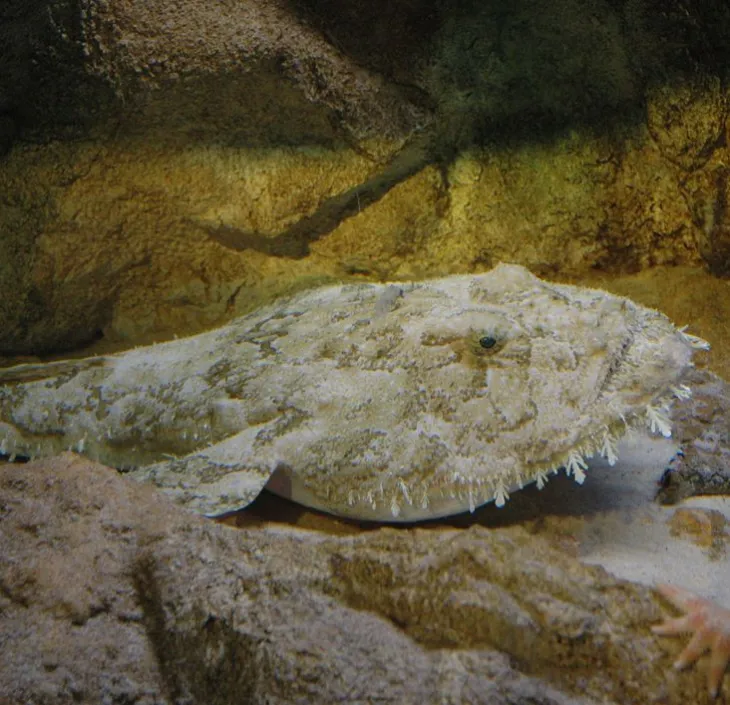
Its enormous flattened head counts for 60% of its total weight. Its enormous mouth is invisible when closed.
As a fish approaches, it opens its mouth and sucks in its prey. You name it, they can eat it: fish, crustaceans and even sea birds.
A benthic fish, that’s to say one that lives on the seabed, the common anglerfish is an opportunistic fish that uses camouflage to disappear from the sight of its prey, and which waves a lure to attract them.
There is a total of seven species in France but the two most commonly found at our fishmonger’s are the common anglerfish (Lophius piscatorius) and the blackbellied angler (Lophius budegassa).
The common anglerfish can be found from the north of Norway down to the coast of West Africa, and also in the Mediterranean and the Black Sea. They live at depths of between 20 and 1,000 metres.
They live over loose seabeds, and also over rocky substrates very close to the coast, but have already been caught at a depth of 1,800 metres.
One of the anglerfish’s characteristics is that they produce eggs that agglomerate in the form of a gelatinous ribbon. This ribbon can be more than 10 metres long, and comprises several million eggs. This sheet drifts around until the eggs hatch. The larvae live a pelagic life for several years before going down to live on the seabed when they reach a length of 5 to 6 cm.
Anglerfish have a lifespan of about 25 years (21 for the males). Their slow growth goes with a late sexual maturity when the fish reach a length of 70 cm. These characteristics make them vulnerable to overfishing, all the more so as the juveniles are sometimes caught before they have even had the time to reproduce.
They have a very slow breathing rate (1 to 2 minutes between each expiration) which gives them a very great resistance to emersion.
The anglerfish’s commercial name is monkfish. It is a much sought-after fish whose tail and cheeks are eaten. It has a high commercial value. At the fishmonger’s it is displayed without its head. They are caught by trawling.
VOYAGE EN HAUTE MER
The Ocean Mag
In the spotlight
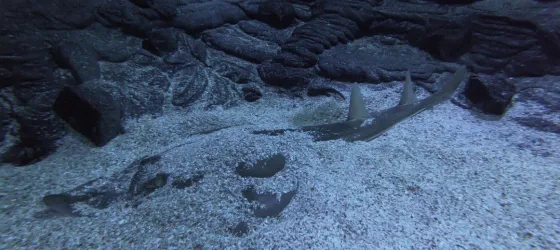
Comment la raie guitare fouisseuse va bénéficier des arrondis en caisse des visiteurs de Nausicaá.
Article
Ovipare ou vivipare aplacentaire, chez les raies, il existe plusieurs modes de reproduction.
Article
A new El Niño event, described as “very strong”, is set to occur from this spring onwards.