Biodiversity 5mn
Do you know about the rays at Nausicaá?
Ten species of rays can be found in the three visitor areas at Nausicaá.

"Rays are flat and live on the seabed."
That's a bit short, young man! You could also have said: it's flat, certainly, but it's also airy, graceful, mysterious... and above all, very close to sharks!
During your visit to Nausicaá, as you explore the different exhibits, you will discover no fewer than nine species of ray, each with its own appearance, environment and personality.
Are all rays the same? Is a cold-water ray simply a flatfish comparable to the rays in the large basin... or to those that live in fresh water?
A brief overview of the rays at Nausicaá, to help you tell them apart.
Mankind and shores
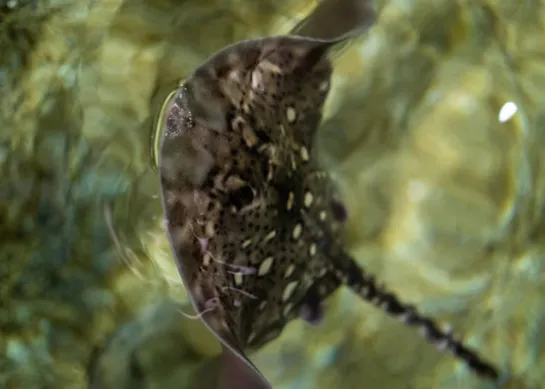
Thornback Skate, a diamond-shaped skate
Found in the touch pool at Nausicaá, the thornback skate Raja clavata can be recognised by its diamond-shaped silhouette, like its cousin the spotted skate. It has curled patterns on its body, whereas the spotted skate Raja montagui has a brownish body covered with dark spots.
As benthic fish, these rays live near the bottom and hide easily in the sand, ready to pounce on their prey, which they crush with their flat teeth. The Thornback Skate is classified as "Near Threatened" on the IUCN Red List, while the spotted skate is classified as "Least Concern".
Journey on the High Seas
Guitarfish, half-skates...
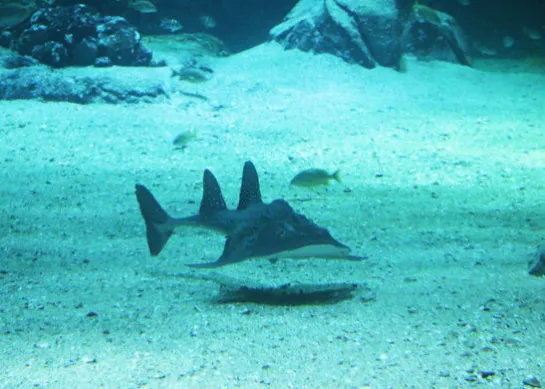
If there is one fish that intrigues people, it is the guitarfish. Standing in front of the large tank, visitors ask themselves: "Is it a shark? Why does it have such a flat head?"
The answer is simple... and surprising: it's not a shark, but a skate!
The guitarfish has a flattened head, common among skates, but the rear of its body, with its elongated trunk and well-developed caudal fin, is reminiscent of a shark.
... half-sharks
The confusion is all the more understandable when you see it moving. The guitarfish swims by undulating its tail like a shark, rather than by flapping its pectoral fins.
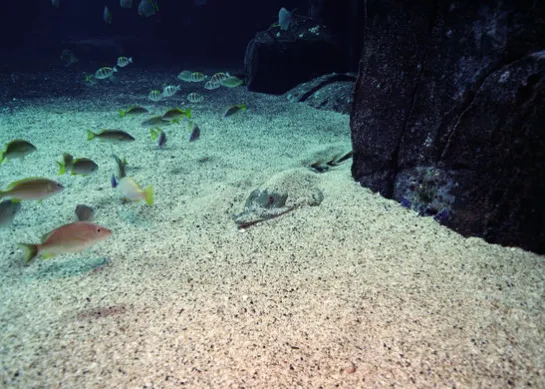
Two species of guitarfish coexist in the large tank at Nausicaá: the pointed-nosed Blackchin Guitarfish Glaucostegus cemiculus and the Bowmouth guitarfish Rhina ancylostomus with a rounded front end.
Both species are classified as "critically endangered" on the IUCN Red List.
Journey on the High Seas
Stingrays, round-bodied rays
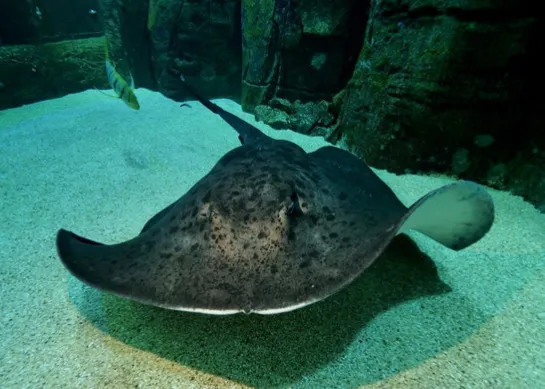
Stingrays have a disc-shaped body of varying thickness and all possess a venomous sting.
At Nausicaá, two Blotched Fantail Rays live in the large pool. Their large round bodies, which exceed 1.5 metres in width, make them easy to spot. They are classified as "Vulnerable" on the IUCN Red List.
Mankind and shores
The Bluespotted Lagoon Ray
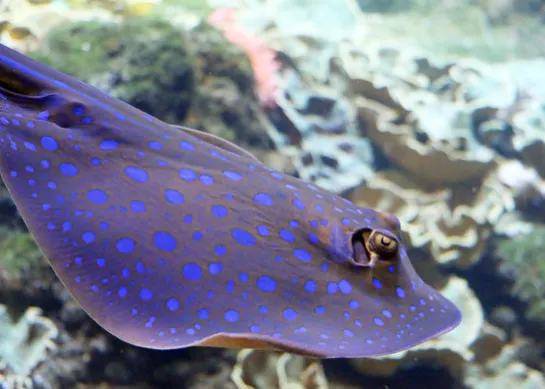
In the lagoon, a blue-spotted stingray swims among tropical species. Smaller than its counterpart in the main basin, it is easily recognisable by the blue spots scattered across its round body.
It is classified as "Least Concern" on the IUCN Red List.
Mankind and shores
The Ocellate River Stingray, a freshwater ray
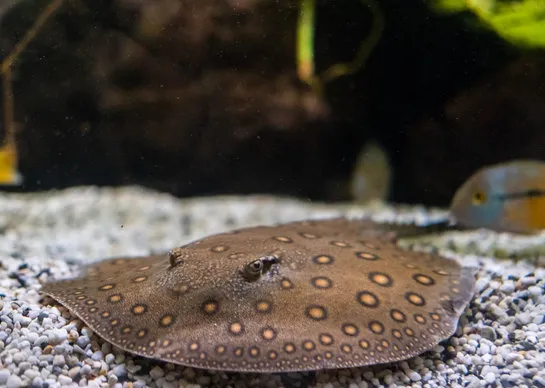
TheOcellate River Stingray is the only species of freshwater ray on display at Nausicaá. Like its marine cousins, it has a venomous sting, which can measure up to 50 cm in the largest individuals.
At Nausicaá, it can be observed in the Submerged Forest area, where it usually hides, or in the exhibition "The Eye of the Climate". It is classified as "Least Concern" on the IUCN Red List.
Journey on the High Seas
The Mobulidae family
Two species of manta rays live in the large pool at Nausicaá.
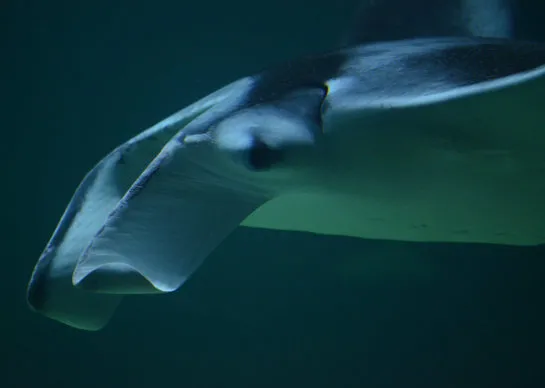
The Oceanic Manta Ray Mobula birostris is the largest ray in the world. The manta ray at Nausicaá now measures 4 metres across and weighs 800 kg. You can't miss it! It moves by undulating its pectoral fins, which gives the impression that it is flying over the water. It can be recognised by the two cephalic protuberances on either side of its large mouth, which act as a "funnel" to better direct food towards its mouth.
Journey on the High Seas
Atlantic Pygmy Devil Rays
Atlantic pygmy devil rays (Mobula hypostoma) belong to the same family as the giant manta ray. Smaller in size, they reach a maximum length of 1.2 metres. They can also be recognised by their cephalic protuberances and long tail without a spine.
These two species of ray are classified as "Endangered" by the IUCN and are the subject of conservation and research projects in which Nausicaá participates.
Journey on the High Seas
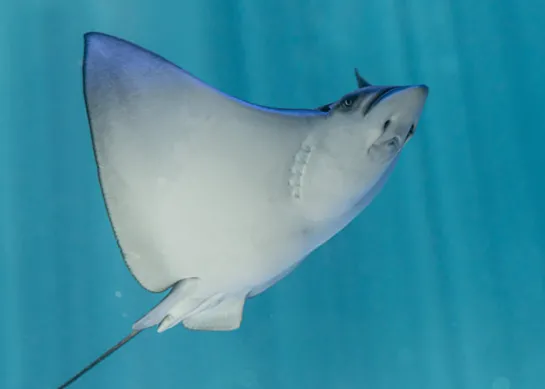
Spotted Eagle Ray
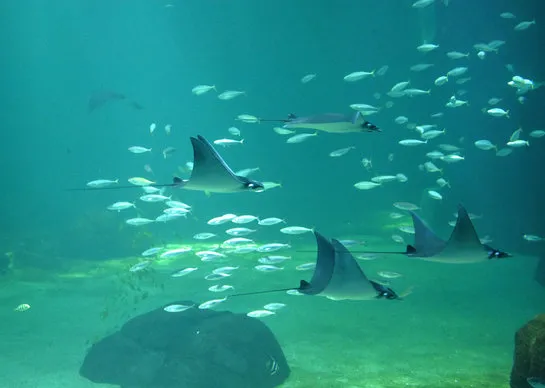
Eagle rays (Aetobatus ocellatus) belong to the Aetobatidae family. They also have a diamond-shaped body and swim by undulating their large pectoral fins, but their feeding habits are very different.
While manta rays filter plankton through their cephalic fins, eagle rays feed on gastropods, molluscs and crustaceans, which they crush with their grinding teeth.
They can reach a wingspan of over 3 metres and weigh up to 200 kg, making them sometimes even larger than devilfish.
Despite their differences, they share a worrying commonality: like Mobula rays, the eagle ray Aetobatus ocellatus is now classified as Endangered by the IUCN, mainly due to fishing pressure and habitat degradation.
Conservation at Nausicaaá
Nausicaá is committed to preserving biodiversity by participating in European conservation programmes within EAZA, the European Association of Zoos and Aquaria.
Other articles
The sharks of Nausicaá: have you seen th...
Biodiversity 4mn
Do you know how many species of sharks there are to discover...
What are the new species in the Tropical...
Biodiversity 2mn
New species are enriching the exhibition's ponds.
Did you know? Behind the scenes of repro...
Biodiversity 4mn
Fish, prawns, sharks, animals that reproduce or are bred at ...