Coral 8mn
10 things you need to know about coral
Coral, the planet's largest builder, is a fragile and threatened animal.

I'm a primitive body with a single orifice and stinging tentacles that appeared in the Precambrian 900 million years ago.
I'm the biggest builder on the planet and I live in symbiosis with a seaweed, I'm... coral!
- Coral is an animal
- Hard or soft, coral is everywhere
- A bit of limestone?
- Zooxanthella + coral = <3
- The jellyfish is its cousin
- Small but visible from space
- Small but with superpowers
- In the middle of the reefs, an explosion of life
- Fluorescent coral
- Endangered corals
Coral is an animal
Animal, vegetal or mineral? Hard to tell at first glance
Coral, known since ancient times, has long intrigued naturalists. Considered as a stone but also as a plant, it was not until the 18th century that scientists definitively considered it as an animal.
In Greek mythology, Perseus cuts off the head of Medusa, the Gorgon, whose eyes petrify those who meet her gaze. Laying his head on the sand to wash his hands, he saw Medusa's blood flow into the sea and onto the seaweed, petrifying it and turning it into... coral.
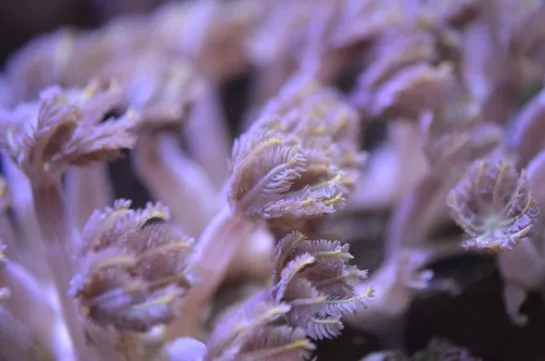
Hard or soft, corail is everywhere
Corals can form colonies or be solitary polyps. And although the majority of corals are found in warm waters close to the surface, there are also cold-water or deep-water corals: in 2020, 116 new coral reefs were discovered in the open sea between 200 and 1,200 metres below the surface.
Of the 1,400 species of hard and soft corals in the world, 850 are reef-building corals. These are known as Scleractinians.
A bit of limestone?
Coral synthesises limestone throughout its life...
... and there are two types of coral:
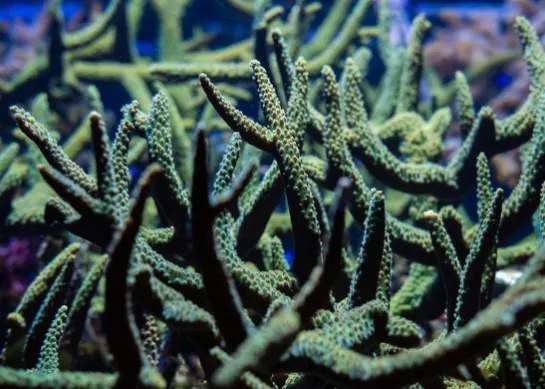
- Those capable of producing an exoskeleton, which are hard corals such as Acropora, Porites and Euphyllia.
- Those whose limestone synthesis supports the coral tissues are soft corals.
Branching, tabular or massive with rounded shapes, hard coral is a builder and forms a reef by welding together.

Zooxanthellae + coral = <3
To produce its skeleton and build the reef, the coral hosts a micro-algae in its tissues.
Zooxanthellae help to precipitate calcium dissolved in the water by absorbing carbon dioxide from the water during photosynthesis, and provide the coral with oxygen and carbohydrates, essential nutrients for the growth of its skeleton.
In return, the coral provides the zooxanthellae with carbon dioxide (CO₂) and nitrogen compounds. Living in the coral's tissues, this micro-alga finds shelter and protection there. Thanks to this symbiotic relationship, coral can survive in nutrient-poor environments, with the zooxanthellae covering 70-90% of its energy needs.
This is why the vast majority of reefs develop between the surface and a depth of around thirty metres, in clear, bright, warm waters: the corals expose their algae to the sun so that they can carry out their mission: photosynthesis!
The jellyfish is its cousin
In the Cnidaria family, I ask for the coral!
And the jellyfish, and also the gorgonian or the anemone, which the coral polyp resembles.
All belong to the group of Cnidaria, which are stinging animals. Corals use their stinging cells to defend themselves or to feed.
Contact with certain corals, including the Fire Coral, can cause burns or skin irritation to careless or overly curious divers.
Small but visible from space
Coral is a tireless builder,
... capable of creating reefs several thousand kilometres long.
The Great Barrier Reef, located in north-east Australia, covers an area of around 344,400 km² and is 2,300 km long. It is the largest living structure produced by organisms, visible to the naked eye from space!
Listed as a UNESCO World Heritage Site since 1981, it is home to more than 1,500 species of fish, around 400 species of coral, 4,000 species of molluscs and almost 240 species of birds, as well as a wide variety of sponges, anemones, marine worms, crustaceans and other species.

Small but with superpowers
Reefs are very useful to humanity, making them a key element in the balance of the coral ecosystem.
- Coral reefs act as a barrier against the force of waves, mitigating up to 90% of their impact. They thus protect the coastline from coastal erosion.
- As it grows, it accumulates carbon in the form of calcium carbonate in its skeleton, thus becoming a carbon sink.
It could provide 21st-century medicine with essential molecules: many reef organisms produce powerful biochemical substances, which are being studied for their effects on arthritis, cancer and other diseases.
In the middle of the reefs, an explosion of life
A record-breaking ecosystem!
Although this ecosystem represents only 0.2% of the ocean's surface area, it is home to 30% of known marine biodiversity, i.e. around 100,000 species - the greatest biological diversity on Earth!
There are around 1,000 species of coral, 25,000 molluscs, 8,000 fish and other vertebrates and tens of thousands of other animals such as crustaceans, starfish, sea urchins and marine worms.
A multitude of species at the base of the marine food chain reproduce here and find shelter and food. This marine wealth is a precious resource for the local populations who feed on the species present in the reefs.
It is one of the marine ecosystems that produces the most living biomass.

Fluorescent coral
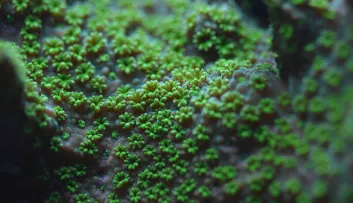
Most corals fluoresce because they contain molecules called GFP (Green Fluorescent Protein) that absorb invisible light and re-emit it in the form of visible green, yellow or red light.
The precise role of this fluorescence is not yet known. However, it is possible that in poorly lit areas, the fluorescence transforms the blue light, which penetrates deep into the water, into useful light for the zooxanthellae, helping them to photosynthesise. This would enable corals to survive in environments where light is scarce.
Other hypotheses suggest that fluorescence could protect corals living near the surface from UV rays or free radicals, like sun protection.
Finally, some hypotheses put forward fluorescence as a defence mechanism against predators or a predation mechanism to attract prey.
Endangered corals
Corals suffer the effects of climate change
This translates into :
Coral bleaching: various stresses, including pollution and rising water temperatures, lead to the expulsion of zooxanthellae and ultimately the death of corals.
On 15 April 2024, NOAA (in partnership with the International Coral Reef Initiative) confirmed that the world was in the midst of its fourth episode of coral bleaching. "Between January 1, 2023 and April 20, 2025, bleaching-type thermal stress affected 83.7% of the world's coral reef area and mass coral bleaching was documented in at least 83 countries and territories."
Ocean acidification affects the calcification of coral skeletons.
Intensive fishing, immoderate harvesting, spills of polluting substances, landfill practices and growing demographic pressure are also threatening the survival of corals.
What are the solutions for preserving coral reefs?
- Limit global warming: by reducing the current level of greenhouse gases and developing sustainable energy production.
- Optimising the resilience of coral reefs: by controlling human activities that damage the state of the reefs to allow the corals to regenerate, by combating pollution or by managing coastal areas in a way that does not impact the reef (coastal development)
- Increase the number of marine protected areas
- Protect isolated coral reefs: some coral reefs are far from any human activity; by protecting them, they could serve as a reservoir of biodiversity.
- Restoring reefs: associations are taking action on the ground by installing artificial reefs. The submerged structures are home to coral cuttings that gradually attract new marine species.
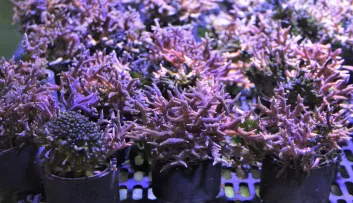
- Nausicaá takes coral cuttings which are then displayed in the exhibitions. Since 2020, Nausicaá has been taking part in the World Coral Conservatory, which aims to preserve the genetic heritage of threatened corals.
Sources :
Fonds français pour l'environnement mondial
Help preserve marine biodiversity by making a donation to Nausicaá
The Nausicaá Endowment Fund supports :
- Active reef restoration: in partnership with The Coral Planters, which works to restore coral reefs,
- Research and innovation: in collaboration with Corail Artefact and the Polynesian Institute of Biomimicry (IPB), to develop faster, more sustainable restoration methods adapted to climate challenges.
Other articles
What is a coral reef?
Coral 9mn
Discover the coral ecosystem, an extraordinary garden under ...
Selective breeding to restore coral reef...
Biodiversity 2mn
Genetic selection is the key to coral restoration.
How does coral reproduce?
Coral 3mn
How does a coral polyp become a reef?
Nausicaá takes part in coral conservatio...
Coral 3mn
Public aquariums, working together to preserve corals.

What is coral?
Coral 1mn
Animal or vegetal? Nausicaá and Esprit sorcier explain what ...