Mangrove 7mn
10 things you need to know about mangroves
The mangrove, a forest with its feet in the water, is an essential ecosystem for tropical marine life.

Let's take a look at what a mangrove consists of and what it does.
- At the origin there is a mangrove
- An environment between land and sea
- The mangrove, a refuge for biodiversity
- Life in the water and in the trees
- Protection against natural events
- The mangrove is a carbon sink
- Water filtration and purification
- Where are mangroves found?
- What are the threats to mangroves?
- What are the solutions?
At the origin there is a mangrove
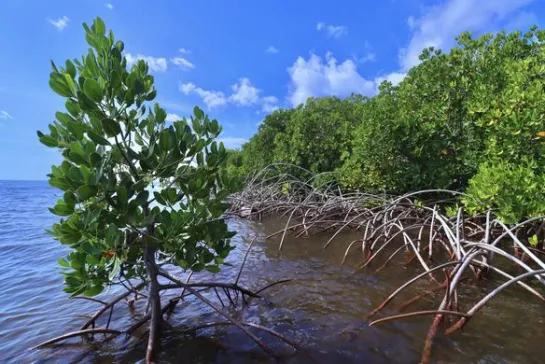
Trees, feet in the water
The mangrove is a unique tropical coastal ecosystem, made up of forests that literally live with their feet in the water. And at the heart of this ecosystem, the mangrove plays a vital role: it is to the mangrove what coral is to the coral reef, the essential building block of a precious ecosystem for marine biodiversity.
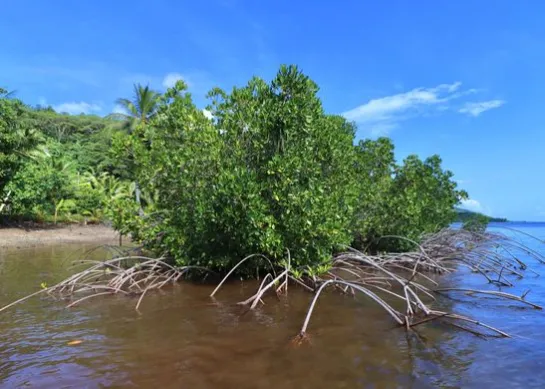
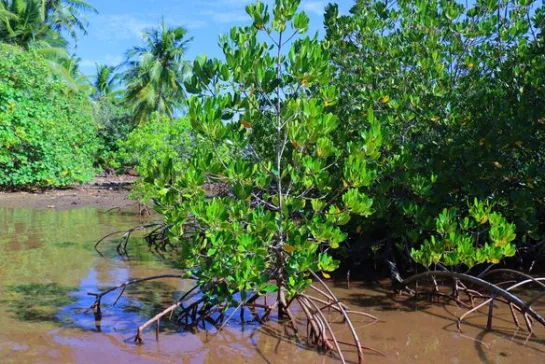
Mangroves thrive in brackish water and oxygen-poor soil. It has aerial roots that capture oxygen from the air and it draws the nutrients it needs from the water. Another special feature is that it expels excess salt through its leaves.
It also reproduces in a special way. A pod, called a propagule and containing a young shoot, falls from the tree, floats for several months in the water and travels long distances before gorging itself with water and sinking into the mud to take root.
An environment between land and sea
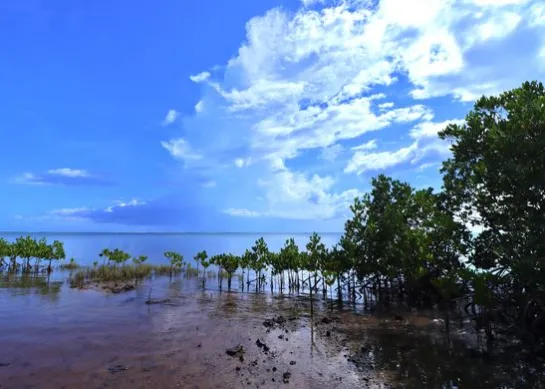
This tropical coastal ecosystem, found in lagoons, estuaries and bays, develops between land and sea and lives to the rhythm of the tides, which bring in salt water. This mixes with freshwater from rivers, whose mouths provide an environment that is conducive to the development of mangroves.
It is the balance between fresh and salt water that allows these species to flourish. In the event of drought, excess salt can harm the development of certain plants.
Mangroves, a refuge for biodiversity
A rich and surprising animal life
This tropical environment is home to a rich biodiversity. Fish, crabs, birds and reptiles find food and shelter here. In India alone, mangroves are home to 5,746 species, including 4,822 animal species.
Mangroves are nurseries for many species, which grow up there during the juvenile period before moving to the open sea. For other species, such as periophthals, fiddler crabs and arching fish, the mangrove is their permanent home.
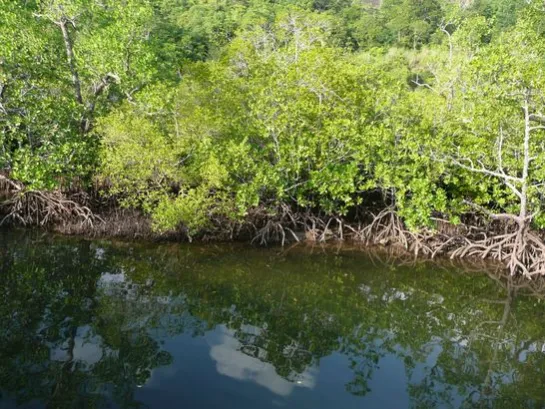
Life in the water and in the trees
This rich ecosystem is home to thousands of species. Crabs and insects feed on leaves, while others such as microbes and fungi turn to decomposing matter.
Monkeys, birds, insects and other plants live in the mangrove branches. In the water, sponges, snails, worms, anemones, barnacles and oysters attach themselves to the roots.
Mangroves are also home to many fish populations. The importance of this habitat is such that the loss of 2.5 km² of mangrove would result in the loss of 124 tonnes of fish.
Protection against natural events
Mangroves, a natural barrier
Mangroves act as an effective natural barrier against coastal erosion, storms and the force of waves, the impacts of which are exacerbated by climate change.
Mangroves protect both marine ecosystems and the biodiversity that lives there, and ensure the survival of the local communities that depend on them.
The mangrove is a carbon sink
Mangroves act as carbon sinks, absorbing and storing carbon in their sediments. Mangroves capture atmospheric carbon through photosynthesis in their trunks, branches and leaves. Once dead, these form a litter of organic matter that sinks into the damp, oxygen-poor mangrove soil, where it retains the carbon in the sediments. This is known as "blue carbon".
Mangroves store almost 11 billion tonnes of carbon, almost three times the amount stored by tropical forests of the same size. Mangroves represent less than 2% of marine environments, but they store 10 to 15% of carbon.
Water filtration and purification
Water quality
Mangroves also play an important role in filtering and purifying water. It absorbs nutrients from run-off water, which causes the development of algae harmful to coral reefs and seagrass beds. This purification capacity keeps the water clear and healthy.
Mangrove roots retain sediment, helping to filter the water.
Systemic services provided by mangroves
According to the Global Mangrove Alliance, in 2021, "4.1 million fishermen depended on mangroves". Mangroves are home to "600 billion young shrimp and fish species and 100 billion crabs and bivalves worldwide".
Artisanal fishing in mangroves is an essential source of protein for local populations and a source of income necessary for their survival.
- The mangrove is a nursery for many commercial species such as red mullet, grouper, snapper and flatfish.
- Other resources include wood, salt, honey, fruit and traditional medicines.
- Nature tourism is also a source of income for the local population.
The total economic value of the services provided by mangroves amounts to several tens of billions of dollars per year worldwide.
According to the same report, more than 15 million people worldwide depend on this ecosystem.
Where are mangroves found?
Present in 128 countries and territories in tropical regions
Mangroves account for just 1% of tropical forest area and 0.4% of the world's forest estate.
In surface area, it covers 147,256 km².
- A third of mangroves are found in South-East Asia, mainly in Indonesia, where 21% are found.
- The largest mangrove area in France is in French Guiana, covering 55,140 ha.
- The world's largest mangrove, the Sundarbans, is located in the delta of the Ganges and Brahmaputra rivers, between India and Bangladesh, where the Royal Bengal tiger can be seen.
What are the threats to mangroves?
40% of the world's mangroves have disappeared since 1960 and, according to the IUCN, "half of the world's mangrove ecosystems are threatened with collapse".
What threatens them :
- Deforestation: logging and deforestation for agriculture (rice and palm oil), shrimp farming or urban and tourist development. Shrimp farming is responsible for the loss of 35% of the world's mangroves.
- The construction of dams prevents the inflow of fresh water and the movement of sediment, and increases the salinity of the environment.
- Pollution: hydrocarbons and waste suffocate mangrove roots and prevent them from absorbing oxygen.
- Climate change: rising sea levels submerge mangroves and the increased frequency and intensity of climatic events such as cyclones weaken the growth of young mangroves.
What are the solutions?
Mangroves can be restored by re-establishing mangrove propagules. The choice of location must take account of hydrological and sedimentological conditions to encourage natural establishment of the propagules.
Creating channels to allow water to circulate lowers water temperature and salinity, and increases dissolved oxygen and sediment availability. These elements are essential for the replanting of young mangrove plants that may have grown in the nursery. The success of the operation can be measured by the return of crabs, fish and birds to the rehabilitated environment.
La mangrove
Document à télécharger
Autres articles
10 things you need to know about coral
Coral 8mn
Coral, the planet's largest builder, is a fragile and threat...
What is a coral reef?
Coral 9mn
Discover the coral ecosystem, an extraordinary garden under ...
How does coral reproduce?
Coral 3mn
How does a coral polyp become a reef?
Selective breeding to restore coral reef...
Biodiversity 2mn
Genetic selection is the key to coral restoration.