Biodiversity 3mn
Why do some fish live in shoals?
Strength in numbers! The strategy of schooling behaviour in marine animals.

At the end of the day, in Nausicaá’s large tank, you can observe a change in the animals’ behaviour: the fish slow down, the sharks swim calmly, the giant manta ray seems to glide above them all, and the schools of fish gather together and prepare for the night.
But why do some species of fish live in schools?
One obvious reason: to protect themselves from predators
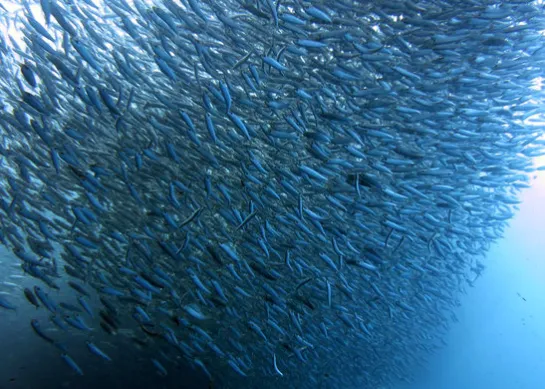
Strength in numbers! The sheer size of the shoal protects the fish from individual attacks. The fish blend into this living mass, and the shoal’s impressive synchronised movements make it difficult for a predator to target them.
Each individual can see its neighbours and also ‘sense’ them via its lateral line. It detects vibrations and movements in the water and can thus adjust its position, speed and direction in response to those of its neighbour.
The way the bench is arranged is a finely coordinated dance!
We are also familiar with the mass migration of zooplankton, whereby these microorganisms rise to the surface in large numbers at night to feed on phytoplankton, then descend again during the day to hide in the depths and escape their predators.
The larger and denser the school, the greater an individual’s chances of survival. This is all the more true given that the group’s collective vigilance ensures an immediate response in the event of danger.
Predators form schools too!
The shoaling strategy is also used by the predators themselves, who, when in large numbers, can easily surround their prey before launching an attack.
Tuna use this technique to swoop down on a school of sardines: they encircle the group of small fish, thereby restricting their escape. This strategy reduces the effort required by each individual, saves energy and proves more effective than a solitary attack in providing access to food for a large number of tuna.
Save energy
Riding in a group
Just as cyclists in the Tour de France conserve their energy by riding in a peloton, fish expend less energy when swimming in shoals.
Moving in a group reduces water resistance in the same way that cyclists experience less air resistance when riding in a group.
Reproduce
Schooling can also facilitate the reproduction of a species whose individuals are found in large numbers in the same area, such as herring or sardines.
A spectacular phenomenon takes place off the coast of South Africa during the southern winter: billions of sardines gather there to spawn, forming a shoal several kilometres long. This event, which aids the species’ reproduction, also provides an exceptional source of food for many predators. Sharks, northern gannets, dolphins, seals and Bryde’s whales take full advantage of this abundance of food.
In 2014, nature photographer Laurent Bellesta documented the impressive gathering of thousands of groupers in the Fakarava Atoll, in French Polynesia. Once a year, at full moon in June or July, males and females release their gametes into the ocean during a unique breeding event. This fleeting event is well known to grey reef sharks, which arrive in their hundreds to feast on this abundance of food.
Other articles
What is parthenogenesis?
Biodiversity 3mn
Having babies all on their own! These females reproduce with...
Why don't fish sink?
Biodiversity 3mn
What is the secret that prevents fish from sinking to the bo...
How do fish breathe underwater?
Biodiversity 2mn
That's why fish don't blow bubbles!