Biodiversity 3mn
What is parthenogenesis?
Having babies all on their own! These females reproduce without males.

Parthenogenesis is a form of asexual reproduction in which embryos develop without fertilisation.
Although commonly associated with plants and insects, particularly bees and aphids, ‘virgin births’—as they are known—also occur in vertebrates.
In this form of reproduction, the female is therefore the sole parent, capable of reproducing without the egg being fertilised by a sperm cell.
And what about the elasmobranchs?
Births via parthenogenesis have been observed in aquariums housing females without any males present.
The best-known case is that of Leonie, a female zebra shark living at the Reef Aquarium in Australia. After mating and reproducing with another zebra shark, Leonie was left alone in her tank, before being joined by her daughter. The two females then laid eggs, which hatched into pups in 2016.
Whilst parthenogenesis has previously been observed in certain female sharks living without males, what was even more surprising in Léonie’s case was this shift from sexual reproduction to parthenogenesis as an alternative mode of reproduction.
Genetic analysis of the babies confirmed the presence of only the female’s genes, leading scientists to rule out the possibility that she might have stored sperm from previous matings and used it for this reproduction.
Parthenogenesis as a strategy for species survival?
The researchers suggest that this choice of reproductive strategy is an adaptation to changes in the shark’s environment, namely the absence of males.
Further cases of adaptive parthenogenesis have been documented in captive elasmobranchs: the common smooth-hound (Mustelus mustelus) in Italy; and in viviparous species such as the bonnethead (Sphyrna tiburo), the blacktip shark (Carcharhinus limbatus), and the whitetip shark (Triaenodon obesus). In oviparous species, births have been documented in the whitespotted bamboo shark (Chiloscyllium plagiosum) and the swell shark (Cephaloscyllium ventriosum). In 2013, parthenogenesis was documented in an ovoviviparous species, the spotted eagle ray (Aetobatus narinari).
In the wild, research by scientists at the Field Museum has revealed that smalltooth sawfish, cousins of critically endangered sharks, sometimes reproduce through parthenogenesis. In Florida, 3% of the sawfish population are born through parthenogenesis.
In any case, the females give birth to more females, maintaining a population that awaits the return of males.
However, the long-term risk is genetic impoverishment of the population, making it more vulnerable to environmental changes or the arrival of a new predator.
Other articles
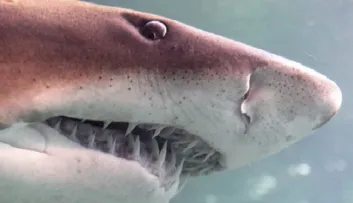
How many teeth do sharks have?
Biodiversity 4mn
A shark would be a dentist's worst enemy !
What do sharks eat?
Biodiversity 4mn
The image of a voracious shark constantly on the lookout for...
Requins et raies : une coalition mondial...
UNOC 3mn
Face au déclin alarmant des requins et des raies, une coalit...