Biodiversity 6mn
Sound and hearing in marine animals: how do they hear?
The ocean, a world of silence? Not at all! Beneath the surface, there is rumbling, crashing, rubbing, clicking, calling out... and even communicating.

The image of the ocean as a world of silence is a thing of the past. Beneath the ocean's surface, marine animals not only hear but also produce sounds, talk and communicate.
How? Let's dive in together and discover the fascinating sounds of the ocean.
The perception of sounds in the ocean
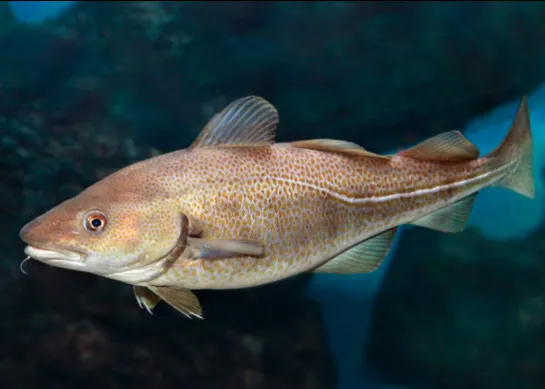
Fish do not have ears, so how do they hear?
Fish do not have external ears or eardrums, but they can hear thanks to their internal ears located in their skulls. The internal ear contains otoliths, small crystals that vibrate with sound waves.
They also perceive waves, vibrations and low frequencies through sensory organs called lateral lines located on their sides.
And what about sharks?
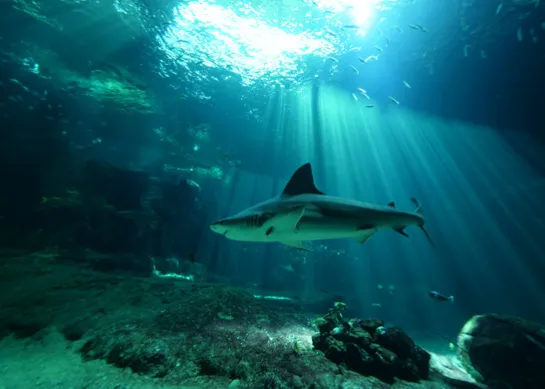
Sharks also do not have external ears. Their hearing relies on an inner ear connected to fluid-filled canals that can detect vibrations. They are particularly sensitive to low-frequency sounds, whose frequencies correspond to the vibrations produced by injured or moving animals. Thanks to this ability, sharks can locate their prey from great distances.
They also have a lateral line to detect movement in the water. To refine the location of their target, sharks use other senses, including smell and electroreception.
How do marine mammals hear?
In marine mammals, hearing and sound production differ between odontocetes (dolphins, orcas, sperm whales) and baleen whales (mysticetes), such as humpback whales.
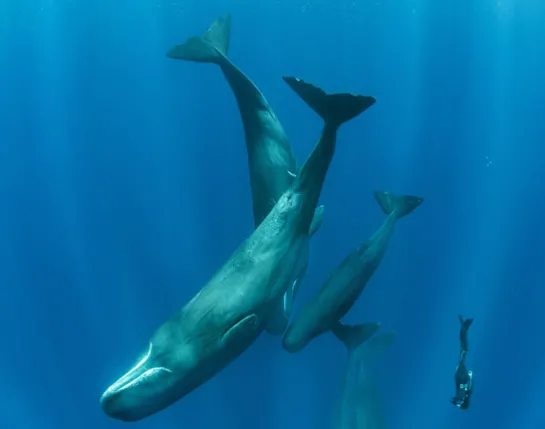
In odontocete cetaceans, sounds are mainly picked up by the lower jaw, which contains layers of fat called mandibular oil. Sound vibrations then pass through the mandible and the middle ear before reaching the inner ear, where they are converted into electrical signals.
Among odontocete cetaceans
The numerous sensory cells in the inner ear of odontocetes give them great sensitivity to high frequencies. They differ from baleen whales in their ability to echolocate.
Odontocetes emit ultrasonic clicks that help them locate obstacles or prey in their environment. When these clicks encounter a target, they return as echoes, are picked up by the jawbone and then analysed by the brain. Dolphins, orcas and sperm whales can thus determine the distance, size, shape, texture and speed of movement of the object.
Among baleen whales
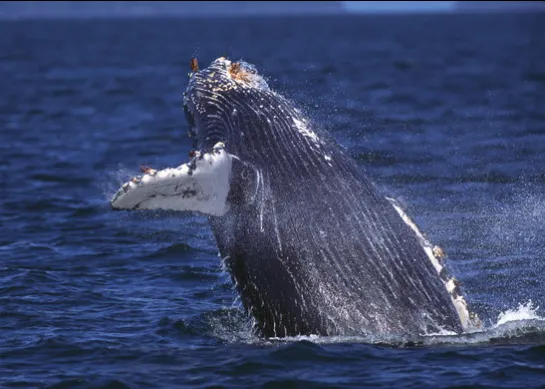
This ability does not exist in baleen whales. They mainly perceive low frequencies, and sometimes infrasound (below 20 Hz), which can travel hundreds of kilometres. They also emit very low-pitched sounds by vibrating the air in their larynx — notably songs, as in the case of humpback whales — which can travel long distances in the ocean.
Pinnipeds such as sea lions and seals can hear just as well in the air as they can in the water. Their whiskers enable them to detect vibrations in the water. Sea lions can be distinguished from seals by their external ears.
Communication among marine animals: how do they do it underwater?
We are familiar with the songs of whales, the clicks and whistles of dolphins and sperm whales, and the barks of sea lions... but how exactly do fish communicate?
Contrary to what one might think, many species of fish also emit sounds. Some produce growling noises by vibrating their swim bladder through the contraction of the muscles surrounding it, such as the tub gurnard.
Others proceed by stridulation, rubbing their fins against their pectoral girdle or grinding their teeth, like the grunts of the Haemulidae family. The clownfish clicks its teeth to signal its presence or defend its anemone.
Shellfish and crustaceans make noise
Other marine animals have surprising ways of producing sounds.
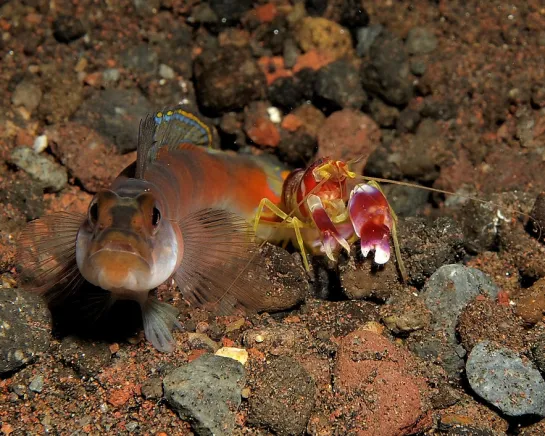
The snapping shrimp, for example, produces a sound similar to a gunshot by snapping its enormous claw... enough to stun its predators. The scallop also makes a snapping sound when it abruptly closes its shell valves. It even sounds like it's sneezing!
As for the common spiny lobster , it emits a sound that can be heard 3 km away by rubbing its antennae against its head.
Are sharks mute?
Sharks, which are cartilaginous fish, have neither bones nor swim bladders. They therefore cannot communicate in the same way as bony fish. For a long time, it was thought that these animals were silent – no, the two haunting notes announcing the great white shark's attack in Jaws do not count.
However, researchers recently recorded short, repeated "clicks" produced by Mustelus lenticulatus smooth-hound sharks during handling in a tank in New Zealand. The sounds may come from the friction of their flat, mosaic-like teeth. This was a surprising discovery for the researchers: in sharks, teeth fall out easily when they come into contact with hard materials.
In 2022, another field study conducted in Indonesia and Australia also recorded clicking sounds emitted by two species of stingrays, the white-spotted black stingray (Urogymnus granulatus) and the black stingray (Pastinachus ater), when approached by divers.
More recently, three species of Mediterranean rays, the smooth ray (Raja brachyura), the rough-skinned ray (Raja radula) and the marbled torpedo ray (Torpedo marmorata), have been reported to produce short, broadband clicks when disturbed by divers.
What are the impacts of human activities on marine animals' hearing and their ability to communicate?
Beneath the ocean's surface, marine animals emit sounds and communicate, but this acoustic universe can be disrupted by human activities.
Human-made underwater noise is now one of the most serious threats to marine mammal communication: maritime traffic, military and civilian sonar, industrial activities such as drilling or offshore wind turbine construction, oil and gas exploration – all these activities are noisy and cause disruption.
Noise disrupts the behaviour of marine mammals, stresses them, disorients them, alters their vital signals and can even cause physical damage. In the long term, it directly threatens the survival of certain animal populations.
Other articles

Why don't fish sink?
Biodiversity 3mn
What is the secret that prevents fish from sinking to the bo...
Do fish have the memory of a goldfish?
Biodiversity 2mn
Is the reputation of the fish with the short memory deserved...
How do fish breathe underwater?
Biodiversity 2mn
That's why fish don't blow bubbles!