Biodiversity 2mn
The colours and patterns of reef fish are not a matter of chance
Why do a Caribbean angelfish and its Indo-Pacific cousin look alike even though they have never come into contact with one another?

An explosion of colours and patterns
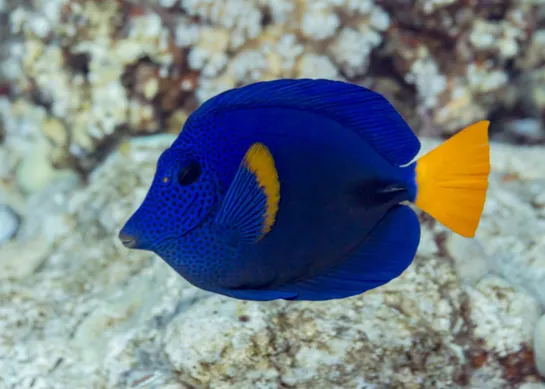
Coral reef fish are among the most colourful animals on the planet. Their visual diversity is breathtaking: horizontal or vertical stripes, round or eye-shaped spots to deter predators, saddle-shaped or labyrinthine patterns.
For a long time, scientists have wondered whether this diversity was the result of local ecological pressures or whether it followed more universal evolutionary principles. How can we explain the resemblance between geographically distant species?
A large-scale study
To shed light on this mystery, researchers at the Laboratory of Evolutionary Ecology at the University of Liège analysed the pigmentation patterns of 918 species belonging to six major families of reef fish: surgeonfish (Acanthuridae), butterflyfish (Chaetodontidae), snappers (Lutjanidae), mullets (Mullidae), angelfish (Pomacanthidae) and damselfish (Pomacentridae).
They assigned a code to each photo, corresponding to thirty different types of patterns. In this way, they compiled a database covering the world’s five major biogeographical regions (Atlantic, Western Indian Ocean, Central Indo-Pacific, Central Pacific and Eastern Pacific).
Common biological mechanisms
First finding: the greater the number of species, the greater the variety of patterns and colours. This suggests that the emergence of new species (speciation) and the importance of being visually recognised by one’s own kind are more significant than local environmental conditions.
Second finding: these patterns evolve rapidly but within a limited scope. Fish quickly explore the possibilities in terms of patterns and colours, but these are constrained by the cellular and developmental processes that govern the formation of ornamentation.
This explains why species that are not related and are geographically distant may end up looking alike. This is known as ‘evolutionary convergence’. It is a process that can be seen, for example, in dolphins and sharks, whose fins can sometimes be confused.
Other articles
Les bébés poissons-clowns aussi se laiss...
Biodiversité marine 2mn
Qui n'a jamais voulu s'habiller comme ses camarades de collè...
Damselfish of the same species do not al...
Biodiversity 2mn
To attract mates, the three-banded damselfish and the reticu...

Comment l'étude de la mangrove peut-elle...
Océan et Climat 2mn
En perçant les secrets des plantes de la mangrove, les cherc...