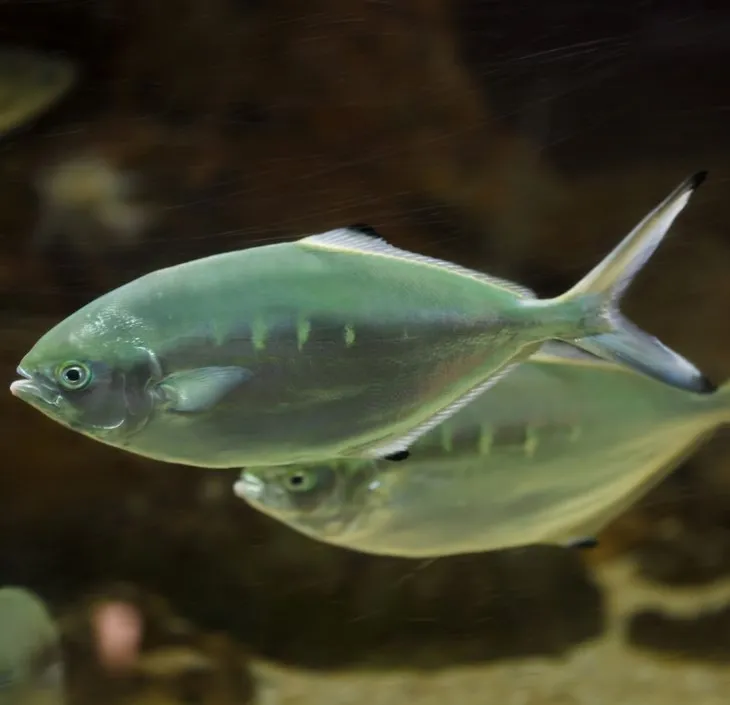
Palomine

Pompano

  Cold and temperate sea fish

Palomine

Identity card

Pompano

Scientific name:
Trachinotus ovatus
Family:
Carangidae
Class:
Actinopterygii
Phylum:
Chordata
Year of description:
Linnaeus, 1758
IUCN Status:
Least Concern
Distribution:

Eastern Atlantic, Mediterranean Sea.

Habitat:

Between 15 and 200 metres, above sandy bottoms.

Size:

Approximately 30 cm, up to 70 cm.

Diet:

Poissons, petits crustacés et mollusques.

Palomine
 

The palomine is a species of trevally.

Florent, Head of the Temperate Zone

Did you know?

Where can I find it?

  • The pompano is a bony fish that swims in open water and is sometimes seen in estuaries. It lives above sandy bottoms, between 15 and 200 metres deep.
  • The young swim in shallow waters, near rocky coasts. 

How can you recognise it?

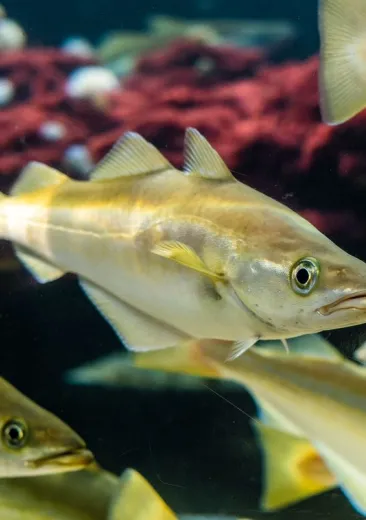
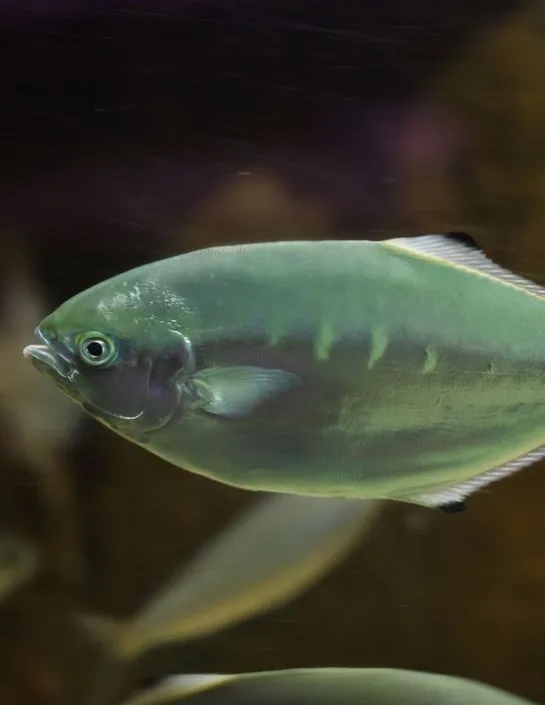
  • The body of the pompano is oval, compressed laterally; the back is pale blue-green with a whitish belly and the sides are shiny and silvery.
  • Its head is rounded with a small mouth.
  • The tips of its fins are black, and its caudal fin is highly bifurcated with pointed lobes, which is characteristic of this species of fast swimmers. The body has a hydrodynamic shape.

What makes it special?

  • The pompano reproduces during the summer, between July and August. The eggs are pelagic.
  • It lives in shoals. Swimming at depths of between 50 and 200 metres, its grey-blue colour protects it from predators.
  • Hunting in groups, it targets shoals of pelagic fish such as anchovies or molluscs such as squid.

Where can I find it at Nausicaá?

Mankind and shores

Palomine

The Ocean Mag

Browse through our Ocean Mag

In the spotlight

À la découverte des animaux marins avec la Voix du Nord

Pour son podcast Les ch'tites histoires, la Voix du Nord a rencontré l'équipage de Nausicaá.

Article

10 things you need to know about coral

Coral, the planet's largest builder, is a fragile and threatened animal.

Article

Why don't young fish look like adults?

In some tropical fish, the changes between birth and adulthood are so great that it is difficult to identify the young.