Identity card

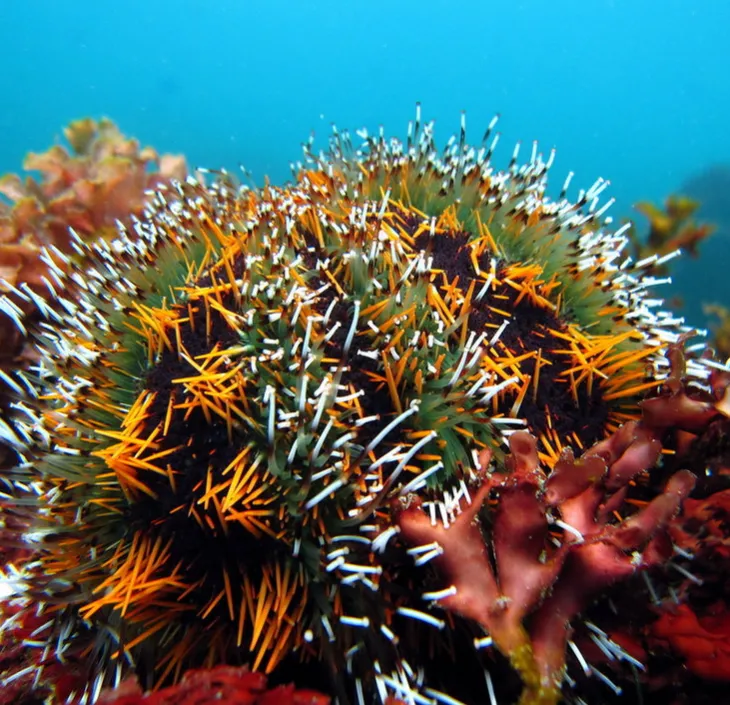
Collector urchin

Scientific name:
Tripneustes gratilla
Family:
Toxopneustidae
Class:
Echinoidea
Phylum:
Echinodermata
Year of description:
Linnaeus, 1758
IUCN Status:
Not Evaluated
Distribution:

Tropical Indo-Pacific: from East Africa to Hawaii and the Galápagos Islands, as far as Japan and Australia. Observed in Réunion, Mayotte, Polynesia and New Caledonia.

Habitat:

Lagoons, seagrass beds, algae-rich flats, reefs, sandy and muddy bottoms. Abundant up to 15 m.

Size:

Maximum diameter of 16 cm.

Diet:

Herbivore that feeds on seaweed.


The name "priest's cap" in French is linked to the appearance of its skeleton.

Its calcareous skeleton, called a test, is spherical in shape and flattened on the top and bottom. It resembles the hats once worn by Catholic priests.

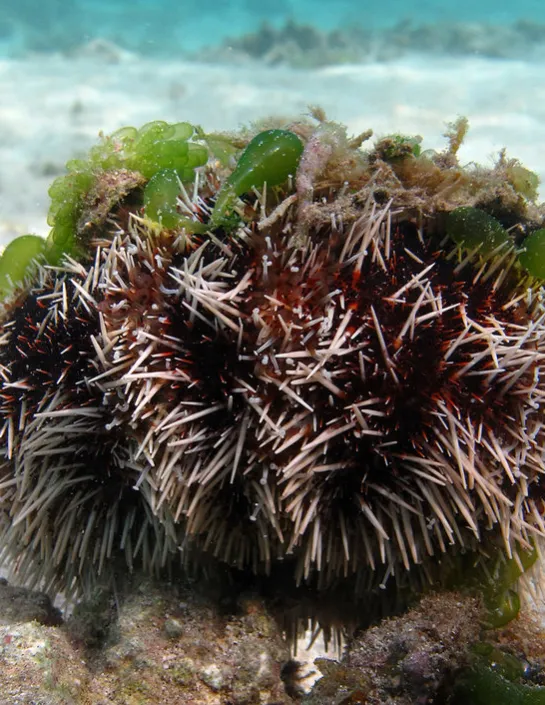
It is called a "collector urchin" in English to illustrate its collector behaviour because it uses its podia (small sucker feet) to hold pieces of seaweed, shell fragments or pebbles on its skeleton. This acts as camouflage against predators (such as triggerfish) and protection against UV rays in very shallow waters.
Where can I find it at Nausicaá?

Mankind and shores

The Ocean Mag

Browse through our Ocean Mag

In the spotlight

Quelles sont les nouvelles espèces dans l’exposition Échappée tropicale ?

De nouvelles espèces viennent enrichir les bassins de l’exposition.

Article

Comment la peau de morue peut-elle soigner des grands brûlés ?

La peau de poisson est utilisée pour soigner les grands brûlés. De déchet, la peau des morues devient un substitut cutané.

Article

All about... Mangroves

The mangrove is a tropical forest with its feet in salt water. Discover it in video.