Where is the animal to be found?
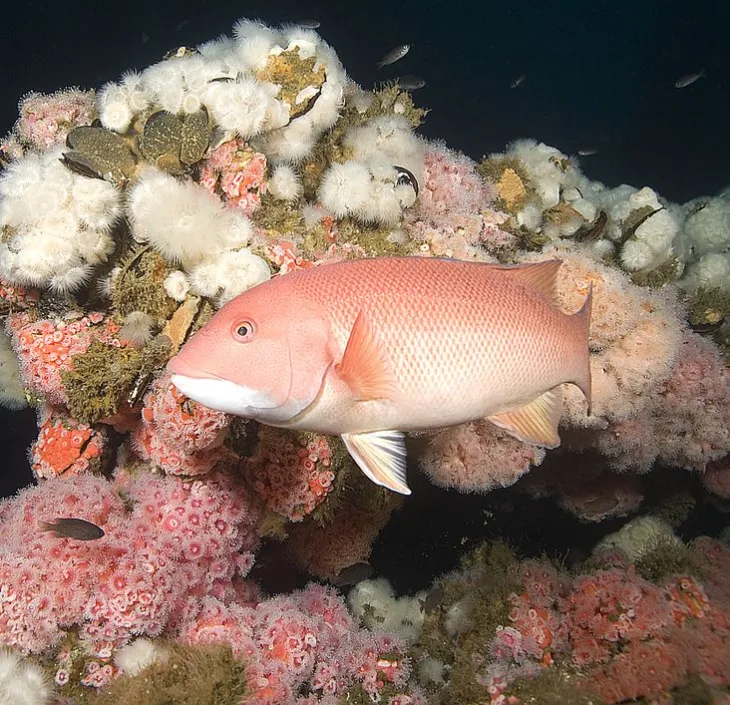
The California sheephead is found on rocky reefs, particularly where there are kelps. This fish tends to stay on the same reef and does not move around much.
The California sheephead hunts actively during the day, but at night, like many wrasses, it wraps itself in a cocoon of mucus, taking refuge in crevices and caves. Hunting predators cannot detect the scent of the fish through the mucus envelope;
How can it be recognised?
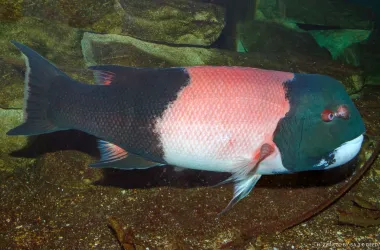
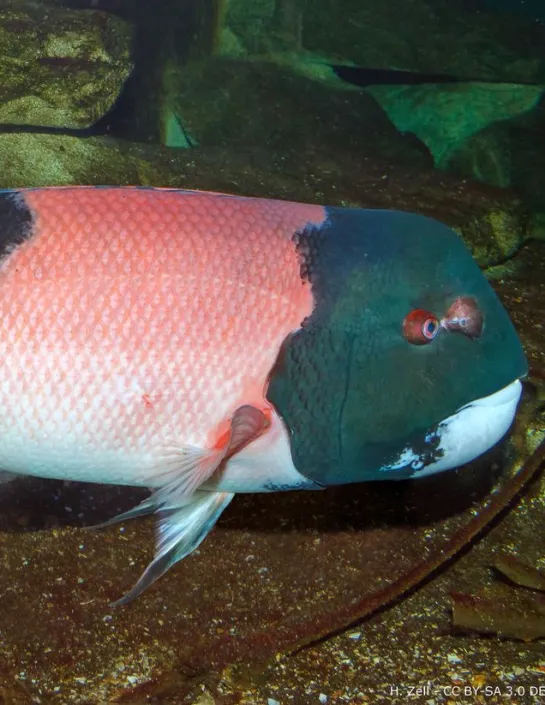
Male and female California sheephead have different colours and morphologies. The male is larger, with a black tail and head, orange-red belly, red eyes and a fleshy hump on the forehead. The female is a dull pink over most of her body.
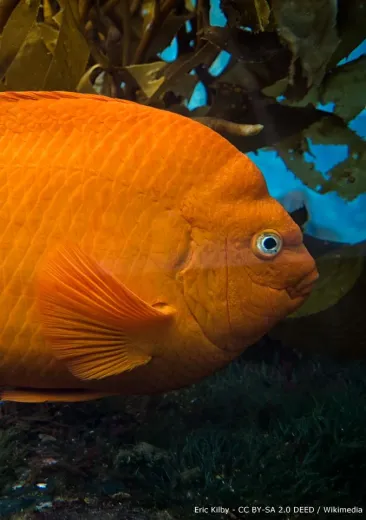
The young wrasse does not resemble an adult. It is orange-red with large black spots on the dorsal fin and upper caudal fin, as well as a white stripe running the length of its body.
What is distinctive about it?
Like all wrasse, the California sheephead changes sex during its life, going from female to male when the male/female balance is unbalanced. The age of sexual maturity and sex change can vary depending on the location of the fish, but also on the abundance of food.
During the breeding season, between June and September, the male becomes territorial and defends his spawning territory, chasing away any smaller male that tries to interrupt the ongoing ballet of reproduction with a female.
It can lay between 130,000 and 375,000 eggs in a day, which hatch into larvae.
Threat and protective measure
In order to control catches of California sheephead and prevent overfishing, the Californian Department of Fish and Wildlife introduced regulations in 2002 limiting the size of catches and the areas where these fish can be caught.