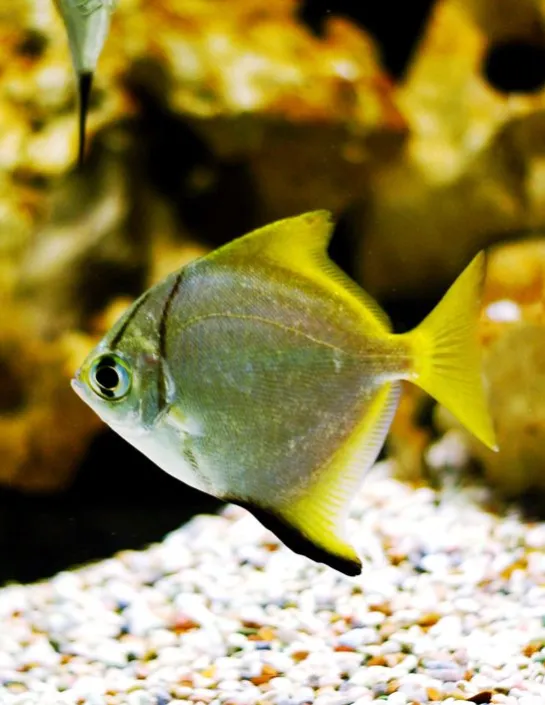
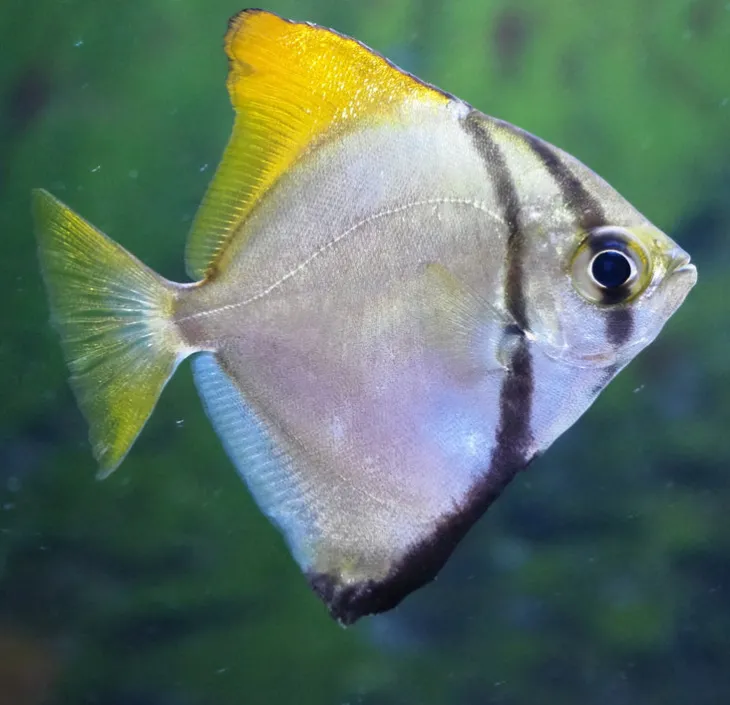
Silver moony

  Fish from the mangroves

Identity card

Silver moony

Scientific name:
Monodactylus argenteus
Family:
Monodactylidae
Class:
Actinopterygii
Phylum:
Chordata
Year of description:
1758 (par Carl Linnaeus)
IUCN Status:
Least Concern
CITES-status:

Not assessed.

Distribution:

Indo-Pacific: Red Sea, east coast of Africa to Australia, New Caledonia, Samoa, Mekong delta.

Habitat:

Mangrove estuaries, bays, tidal rivers, muddy coastal reefs.

Size:

Between 12 and 27 cm.

Diet:

Plankton and detritus.


Ce poisson peut vivre en eau douce, en eau saumâtre ou encore en pleine eau de mer.

En effet, les jeunes naissent souvent en eau douce ou très peu salée et y restent pour se protéger des gros prédateurs marins. En grandissant, ils migrent vers les mangroves et les estuaires dont l'eau est saumâtre. A l'âge adulte, ils vivent dans l'océan, en pleine mer.

Le corps du poisson-lune argenté est compressé au point de sembler disparaitre s'il est de face. Une manière efficace d'échapper à un prédateur.
Where can I find it at Nausicaá?

Mankind and shores

The Ocean Mag

Browse through our Ocean Mag

In the spotlight

Do you know about the rays at Nausicaá?

Ten species of rays can be found in the three visitor areas at Nausicaá.

Raie mante diable

Article

Daily care for the manta ray at Nausicaá

The manta ray fascinates visitors with its majestic appearance. How do aquarists and the veterinarian care for this animal on a daily basis?

Article

What are the new species in the Tropical getaway exhibition?

New species are enriching the exhibition's ponds.